




Is a Cheap Hose Really Worth the Savings?
2026-01-23 11:24
Introduction
Imagine this: you're overseeing a critical production line in a chemical plant. The process relies on a network of hoses to transport aggressive solvents. To save on capital expenditure, your team opted for a budget-friendly hose option. Initially, everything seems fine—until a sudden rupture causes a costly shutdown, environmental concerns, and safety investigations. This scenario isn't just hypothetical; it's a daily reality in industries where the choice between a cheap hose and a reliable one can make or break operations. So, is a cheap hose really worth the savings, or does it hide risks that far outweigh the initial cost?
Pain Points: The Hidden Costs of Cheap Hoses
In the world of industrial manufacturing, hoses are often overlooked as simple conduits. However, their performance directly impacts efficiency, safety, and profitability. Here are three key pain points that arise from using low-quality hoses:
1. Frequent Failures and Downtime: Cheap hoses typically use inferior materials that degrade quickly under stress. In applications like mining or construction, where hoses handle abrasive slurries, a subpar hose might last only weeks instead of months. Each failure not only requires replacement but also halts operations. For a mid-sized facility, this can mean thousands of dollars in lost productivity per incident, plus labor costs for emergency repairs.
2. Safety and Compliance Risks: In sectors such as oil and gas or chemical processing, hoses must withstand extreme pressures and corrosive substances. A cheap hose that lacks proper certifications (e.g., ISO 10380 for rubber hoses) can leak or burst, leading to hazardous spills. Beyond immediate safety threats, this triggers regulatory fines and reputational damage. For example, a minor leak in a refinery could result in six-figure penalties and increased insurance premiums.
3. Reduced Efficiency and Higher Long-Term Costs: Low-quality hoses often have poor flow characteristics due to internal roughness or inconsistent diameters. In hydraulic systems, this inefficiency forces pumps to work harder, increasing energy consumption by up to 15%. Over a year, this adds significant operational expenses, negating any upfront savings from the cheaper hose.
Solutions: Engineering Excellence in Hose Design
Addressing these pain points requires a blend of advanced materials and precision engineering. At ZYfire Hose Corporation, we've developed solutions that prioritize longevity and performance:
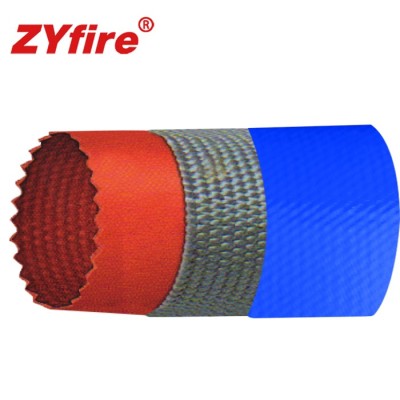
• For Durability: Our hoses incorporate multi-layer constructions with high-tensile synthetic fibers and specialized elastomers. For abrasive environments, we use polyurethane liners that resist wear, extending service life by 300% compared to standard rubber hoses. This reduces replacement frequency and minimizes downtime.
• For Safety: Every ZYfire hose undergoes rigorous testing to meet international standards like SAE J517 for hydraulic hoses. We integrate burst-pressure ratings that exceed operational demands by 400%, ensuring reliability under pressure. Additionally, our hoses are designed with anti-static properties to prevent spark risks in volatile settings.
• For Efficiency: Through computational fluid dynamics (CFD) modeling, we optimize hose inner surfaces to reduce turbulence. This enhances flow rates by up to 20%, lowering energy costs and improving system responsiveness. Our lightweight designs also reduce installation strain, cutting labor time by 30%.
Client Case Studies & Testimonials
Here are three examples of how our solutions have transformed operations globally:
1. Mining Operation in Australia: A copper mine in Queensland switched to ZYfire's abrasion-resistant hoses for slurry transport. Previously, they replaced hoses every two months due to wear. After implementation, hose lifespan increased to eight months, reducing maintenance costs by 60%. "The durability is unmatched—we've cut our hose budget by half while boosting uptime," says site manager, David Chen.
2. Chemical Plant in Germany: A Bayer subsidiary in Ludwigshafen faced leaks in acid transfer lines, risking compliance issues. By adopting our chemically inert hoses with enhanced sealing technology, they eliminated leaks entirely over 18 months, saving €50,000 in potential fines. "ZYfire's hoses are a game-changer for safety and reliability," notes procurement lead, Anja Schmidt.
3. Construction Firm in the United States: A Texas-based company using hydraulic systems for heavy machinery experienced frequent hose bursts under high pressure. After switching to our high-pressure hydraulic hoses, failure rates dropped by 90%, and fuel efficiency improved by 12% due to better flow. "The performance boost has made our projects more predictable and profitable," reports project engineer, Michael Rodriguez.
Applications & Partnerships
ZYfire Hose Corporation serves diverse industries with tailored solutions. Our hoses are integral in:
• Oil & Gas: For drilling mud transfer and offshore applications, where reliability is critical.
• Manufacturing: In automated assembly lines for coolant and lubricant delivery.
• Agriculture: In irrigation systems requiring flexible, weather-resistant hoses.
We collaborate with leading partners to enhance our reach and expertise. For instance, our partnership with Fluid Systems Inc. in Canada allows us to co-develop custom hose assemblies for specialized machinery. Additionally, procurement agreements with major distributors like Industrial Supply Co. in Europe ensure timely availability for clients, reinforcing our commitment to service and innovation.
FAQ: Questions from Engineers and Procurement Managers
1. Q: How do I determine the right hose material for my application? A: It depends on factors like fluid type, temperature, and pressure. For aggressive chemicals, fluoropolymer-lined hoses offer superior resistance, while for high-temperature steam, silicone-based materials are ideal. We recommend consulting our technical datasheets or a sales engineer for a tailored assessment.
2. Q: Are ZYfire hoses compatible with existing fittings? A: Yes, our hoses are designed to standard dimensions (e.g., SAE J516 for hydraulic fittings) for easy integration. We also provide custom crimping services to ensure perfect matches, reducing installation errors.
3. Q: What certifications do your hoses hold? A: Our products comply with ISO 9001 for quality management, along with industry-specific standards like EN 856 for high-pressure hoses. Each batch is tested and certified, with documentation available upon request.
4. Q: How does hose flexibility impact performance? A: Flexibility affects ease of routing and stress on connections. Our huses use spiral-wire reinforcements to balance flexibility with kink resistance, optimizing for tight spaces without compromising durability.
5. Q: Can you provide lifecycle cost analysis for your hoses? A: Absolutely. We offer tools that compare upfront costs vs. total cost of ownership, including factors like maintenance, downtime, and energy efficiency. In many cases, our hoses show a 40% lower total cost over five years compared to cheaper alternatives.
Conclusion & Call to Action
Choosing a hose isn't just about price—it's about investing in reliability, safety, and efficiency. As we've explored, cheap hoses often lead to hidden costs that undermine operational goals. At ZYfire Hose Corporation, we blend cutting-edge technology with real-world expertise to deliver solutions that stand the test of time. Don't let short-term savings compromise your long-term success. To dive deeper into the technical specifics, download our free whitepaper on "Advanced Hose Materials for Industrial Applications" or contact our sales engineers for a personalized consultation. Let's build a safer, more efficient future together.
Related News
More >-
![Why Does Your NBR Hose Fail So Soon?]()
Why Does Your NBR Hose Fail So Soon?
1. Introduction: The hidden cost of premature hose failure 2. Pain Point 1: Abrasion and wear in high-friction environments 3. Pain Point 2: Chemical degradation from oils and solvents 4. Pain Point 3: Ozone and UV cracking in outdoor applications 5. Solutions: How NBR rubber covered hose addresses these challenges 6. Customer Success Stories: Real-world results from ZYfire Hose Corporation 7. Applications and Partnerships: Where NBR hose makes a difference 8. FAQ: Answers to common questions from engineers and procurement managers 9. Conclusion and Call to Action
-
![Why Blue Layflat Hose? The Ultimate Guide]()
Why Blue Layflat Hose? The Ultimate Guide
1. Introduction: The question and the answer 2. Pain Points in Industrial Hose Applications 3. The Blue Layflat Hose Solution 4. Customer Success Stories 5. Applications and Partnerships 6. FAQ for Engineers and Procurement Managers 7. Conclusion and Call to Action
-
![Why Sexless Hose Couplings Are Revolutionizing High-Pressure Industrial Systems]()
Why Sexless Hose Couplings Are Revolutionizing High-Pressure Industrial Systems
1. Introduction: The Hidden Cost of Coupling Failures 2. Pain Points: Leakage, Maintenance Downtime, and Safety Hazards 3. Solution: How Sexless Hose Couplings Eliminate These Issues 4. Customer Success Stories 5. Applications and Partnerships 6. FAQ for Engineers and Procurement Managers 7. Conclusion and Call to Action
-
![Is 50 ft the Optimal Length for Fire Hose?]()
Is 50 ft the Optimal Length for Fire Hose?
1. Introduction: The 50 ft Fire Hose Question 2. Industry Pain Points: When 50 ft Falls Short 3. The Engineering Answer: Why 50 ft Works 4. Real-World Success: Case Studies 5. Applications and Partnerships 6. FAQ for Engineers and Procurement 7. Conclusion and Call to Action
-
![Is Your Key Combat Ready Hose Truly Ready?]()
Is Your Key Combat Ready Hose Truly Ready?
1. Introduction: The critical moment that tests your hose
2. Pain Point 1: Kinking and flow restriction under pressure
3. Pain Point 2: Abrasion and environmental degradation
4. Pain Point 3: Coupling failures and incompatible connections
5. Solutions: Engineering a truly combat ready hose
6. Customer Success Stories
7. Applications and Partnerships
8. FAQ for Engineers and Procurement Managers
9. Conclusion and Call to Action -
![Why 75 Foot Coiled Garden Hose Is a Game Changer?]()
Why 75 Foot Coiled Garden Hose Is a Game Changer?
-
![Why PE Hose Is the Hidden Hero of Industrial Safety?]()
Why PE Hose Is the Hidden Hero of Industrial Safety?
This article explores the critical role of PE hose in industrial applications, addressing common pain points, offering solutions, and showcasing real-world successes. It includes FAQs and a call to action for technical resources.
-
![Why 50 Foot Fire Hose Outperforms Shorter Lines?]()
Why 50 Foot Fire Hose Outperforms Shorter Lines?
A detailed technical blog exploring the critical role of 50-foot fire hose in industrial fire protection, addressing common pain points, solutions, real-world case studies, applications, FAQs, and a call to action for professional guidance.
Get the latest price? We'll respond as soon as possible(within 12 hours)