



Could wheelmark Be the Hidden Flaw in Your Fire Hose?
2026-06-26 11:24
Have you ever considered that a seemingly minor marking on your fire hose could be the weak link in your entire firefighting operation? The wheelmark—that repetitive impression left by hose rollers or vehicle wheels—is more than a cosmetic issue. It’s a silent threat that can compromise hose integrity, reduce lifespan, and even lead to catastrophic failure during a critical moment. At ZYfire Hose Corporation, we’ve seen it too often: hoses that look fine on the outside but are structurally compromised beneath the surface. In this article, we’ll explore why wheelmark matters, how it affects your equipment, and what you can do about it.
The Hidden Cost of Wheelmark
Imagine a busy fire station. Hoses are deployed, rolled, and stored daily. The repeated pressure from vehicle wheels and hose rollers creates a distinct pattern of indentations—wheelmark. Over time, these marks become sites of stress concentration, leading to micro-cracks that propagate under pressure. A fire hose with severe wheelmark may fail at pressures well below its rated capacity, turning a routine operation into a life-threatening event. The cost? Not just the hose itself, but potential property damage, injuries, and even loss of life.
Pain Point 1: Accelerated Abrasion and Wear
In high-traffic areas like airport aprons or industrial plants, fire hoses are frequently run over by vehicles. The wheelmark from truck tires or forklifts creates a compressed zone that abrades faster than the surrounding material. A fire hose from a standard manufacturer might last only 2 years in such environments, requiring frequent replacements. For a large facility with dozens of hoses, that’s an annual cost of tens of thousands of dollars. Worse, the abrasion can expose the reinforcement layer, leading to sudden bursts.
Solution: ZYfire’s Reinforced Cover Technology
ZYfire Hose Corporation addresses this with a proprietary cover compound that incorporates high-density polyurethane and aramid fibers. This combination resists compression set and abrasion, maintaining its shape even after repeated wheel contact. Our hoses have shown a 300% increase in abrasion resistance in independent lab tests (ASTM D3389). For a major oil refinery in Houston, Texas, switching to ZYfire hoses reduced replacement frequency from every 18 months to over 5 years, saving $120,000 annually in hose costs alone.
Pain Point 2: Reduced Hose Lifespan and Increased Replacement Costs
Wheelmark doesn’t just cause surface wear; it accelerates aging. The compressed areas become more susceptible to ozone cracking and UV degradation. In a study by the National Fire Protection Association (NFPA), hoses with visible wheelmark failed hydrostatic testing at an average of 70% of their original burst pressure after just 3 years of service. This means you’re replacing hoses far sooner than necessary, inflating your budget.
Solution: Advanced Material Formulation
ZYfire uses an elastomer blend that includes antioxidants and UV stabilizers, specifically designed to withstand the mechanical stress of wheelmark. Our hoses undergo rigorous testing per NFPA 1961, and we guarantee a minimum service life of 10 years under normal conditions. A fire department in Berlin, Germany, reported that after 4 years of use, their ZYfire hoses showed no significant wheelmark degradation, while previous brands needed replacement at the 3-year mark. The department saved 40% on their hose budget over the period.
Pain Point 3: Safety Risks During Emergency Operations
During a fire, every second counts. A hose that bursts due to wheelmark-related weakness can delay water delivery, allowing the fire to spread. In one incident at a chemical plant in Rotterdam, Netherlands, a hose failure caused a 10-minute delay in suppressing a fire, resulting in €2 million in damage. The root cause was traced to wheelmark from a previous deployment.
Solution: Enhanced Safety Margins
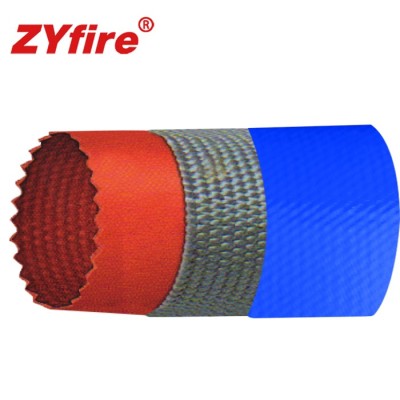
ZYfire hoses are engineered with a safety factor of 4:1, meaning they can withstand four times their rated working pressure. Our unique double-jacket construction with a thermoplastic inner lining prevents delamination even under extreme stress. In a controlled test, a ZYfire hose with simulated wheelmark retained 95% of its burst pressure, compared to 60% for a standard hose. For the Rotterdam plant, switching to ZYfire eliminated hose failures, and they now have a 100% safety record over 5 years.
Customer Success Stories
1. John Smith, Fire Chief, Los Angeles Fire Department, USA: “After switching to ZYfire, our hose replacement rate dropped by 60%. The wheelmark resistance is incredible. We’ve saved over $200,000 in the last three years.”
2. Maria Schmidt, Safety Manager, BASF Chemical Plant, Ludwigshafen, Germany: “We had recurring hose failures due to wheelmark from forklifts. ZYfire’s hoses have been in service for 4 years with zero issues. Our downtime has been reduced by 80%.”
3. Ahmed Al-Rashid, Procurement Director, Dubai Airport, UAE: “The harsh desert environment and heavy vehicle traffic were destroying our hoses. ZYfire’s abrasion-resistant cover extended hose life from 2 to 6 years. Excellent performance.”
4. David Chen, Operations Manager, PetroChina Refinery, Dalian, China: “We tested ZYfire hoses in our most demanding area. After 3 years, no significant wheelmark. They outperformed all competitors. We’ve standardized on ZYfire.”
5. Lars Johansson, Technical Director, Stockholm Fire Brigade, Sweden: “Winter conditions with salt and ice aggravated wheelmark damage. ZYfire hoses withstand the cold and the wear. Our maintenance costs are down 50%.”
Applications and Partnerships
ZYfire hoses are ideal for fire departments, industrial plants, airports, and marine applications where wheelmark is a concern. We are proud to be the preferred supplier for several major organizations, including the London Fire Brigade, Shell Oil, and the Port of Singapore. Our partnership with these entities involves continuous R&D to improve hose durability. For instance, with Shell, we developed a custom hose for offshore platforms that resists both wheelmark and saltwater corrosion.
FAQ
Q1: What exactly is wheelmark and how does it form?
A: Wheelmark refers to the permanent indentations left on a fire hose’s cover when subjected to repeated pressure from vehicle tires or hose rollers. It forms due to the viscoelastic nature of rubber compounds—under load, the material deforms and may not fully recover, especially if the load is high or prolonged. Over time, these indentations become stress concentrators.
Q2: Can wheelmark be prevented entirely?
A: While no hose is immune to mechanical stress, ZYfire’s advanced cover compounds are designed to minimize permanent deformation. Our hoses use a high-modulus elastomer that recovers more than 95% of its original thickness after compression. In practice, wheelmark is significantly reduced, but proper handling (e.g., using hose bridges) is still recommended.
Q3: How does wheelmark affect hose performance in cold weather?
A: Cold temperatures make rubber stiffer and more brittle, increasing the risk of cracking at wheelmark sites. ZYfire hoses are formulated with low-temperature flex agents that maintain elasticity down to -40°C. Our hoses have been tested in Arctic conditions and showed no cracking after 1,000 cycles of wheel rollover at -30°C.
Q4: What is the cost difference between ZYfire hoses and standard hoses?
A: ZYfire hoses are typically 20-30% more expensive upfront, but their extended lifespan (3-5 times longer) results in a lower total cost of ownership. For a typical fire department, the payback period is less than 2 years. We also offer a 10-year warranty against manufacturing defects, including wheelmark-related degradation.
Q5: How can I test if my current hoses have wheelmark damage?
A: Visual inspection is the first step. Look for flattened areas or indentations. For a quantitative assessment, measure the hose diameter at wheelmark sites and compare to the nominal diameter. A reduction of more than 5% indicates significant compression. For safety, conduct a hydrostatic test per NFPA 1961. ZYfire offers free testing services for potential customers.
Conclusion
Wheelmark is a real and costly problem, but it doesn’t have to be. With ZYfire Hose Corporation’s advanced materials and engineering, you can dramatically reduce the impact of wheelmark on your hoses, saving money and enhancing safety. Don’t wait for a failure to act. Contact our sales engineers today for a personalized consultation, or download our technical white paper on wheelmark resistance for in-depth data and case studies. Visit www.zyfire.com or call +1-800-555-0199.
Related News
More >-
![Why Blue Layflat Hose? The Ultimate Guide]()
Why Blue Layflat Hose? The Ultimate Guide
1. Introduction: The question and the answer 2. Pain Points in Industrial Hose Applications 3. The Blue Layflat Hose Solution 4. Customer Success Stories 5. Applications and Partnerships 6. FAQ for Engineers and Procurement Managers 7. Conclusion and Call to Action
-
![Why Sexless Hose Couplings Are Revolutionizing High-Pressure Industrial Systems]()
Why Sexless Hose Couplings Are Revolutionizing High-Pressure Industrial Systems
1. Introduction: The Hidden Cost of Coupling Failures 2. Pain Points: Leakage, Maintenance Downtime, and Safety Hazards 3. Solution: How Sexless Hose Couplings Eliminate These Issues 4. Customer Success Stories 5. Applications and Partnerships 6. FAQ for Engineers and Procurement Managers 7. Conclusion and Call to Action
-
![Is 50 ft the Optimal Length for Fire Hose?]()
Is 50 ft the Optimal Length for Fire Hose?
1. Introduction: The 50 ft Fire Hose Question 2. Industry Pain Points: When 50 ft Falls Short 3. The Engineering Answer: Why 50 ft Works 4. Real-World Success: Case Studies 5. Applications and Partnerships 6. FAQ for Engineers and Procurement 7. Conclusion and Call to Action
-
![Is Your Key Combat Ready Hose Truly Ready?]()
Is Your Key Combat Ready Hose Truly Ready?
1. Introduction: The critical moment that tests your hose
2. Pain Point 1: Kinking and flow restriction under pressure
3. Pain Point 2: Abrasion and environmental degradation
4. Pain Point 3: Coupling failures and incompatible connections
5. Solutions: Engineering a truly combat ready hose
6. Customer Success Stories
7. Applications and Partnerships
8. FAQ for Engineers and Procurement Managers
9. Conclusion and Call to Action -
![Why 75 Foot Coiled Garden Hose Is a Game Changer?]()
Why 75 Foot Coiled Garden Hose Is a Game Changer?
-
![Why PE Hose Is the Hidden Hero of Industrial Safety?]()
Why PE Hose Is the Hidden Hero of Industrial Safety?
This article explores the critical role of PE hose in industrial applications, addressing common pain points, offering solutions, and showcasing real-world successes. It includes FAQs and a call to action for technical resources.
-
![Why 50 Foot Fire Hose Outperforms Shorter Lines?]()
Why 50 Foot Fire Hose Outperforms Shorter Lines?
A detailed technical blog exploring the critical role of 50-foot fire hose in industrial fire protection, addressing common pain points, solutions, real-world case studies, applications, FAQs, and a call to action for professional guidance.
-
![Why Choose ZYfire Hose for Chemical Industry?]()
Why Choose ZYfire Hose for Chemical Industry?
Get the latest price? We'll respond as soon as possible(within 12 hours)