




Is Your Irrigation System Wasting 40% of Water?
2026-05-07 08:35
Imagine this: You walk through your field on a scorching July afternoon. The soil is cracked, yet your sprinklers are running full blast. Water pools in the low spots, while the ridges remain dry. You check your water bill and realize you're paying for water that never reaches the roots. This is the reality for many growers using traditional irrigation. The answer? Porous hose irrigation—a technology that delivers water precisely where it's needed, cutting waste by up to 40%. ZYfire Hose Corporation has been at the forefront of this innovation for over a decade.
Pain Points: The Hidden Costs of Conventional Irrigation
1. Uneven Water Distribution
In a 50-acre vineyard in Napa Valley, California, the owner noticed that some vines were overwatered, leading to root rot, while others were stressed from drought. This inconsistency resulted in a 15% yield loss and increased labor costs for manual watering. The cost of water itself rose by 20% as they tried to compensate.
2. Clogging and Maintenance Nightmares
A dairy farm in the Netherlands used drip tape for their pasture irrigation. Within two seasons, mineral buildup and algae clogged 30% of the emitters. Replacing the tape cost €12,000, and the downtime during installation caused a 5% drop in milk production due to heat stress.
3. High Water Consumption
In the arid region of Alicante, Spain, an almond grower was using overhead sprinklers. Evaporation losses reached 35%, and the water footprint was unsustainable. Local regulations threatened to cap their usage, risking a 50% reduction in irrigated area.
Solution: Porous Hose Technology by ZYfire
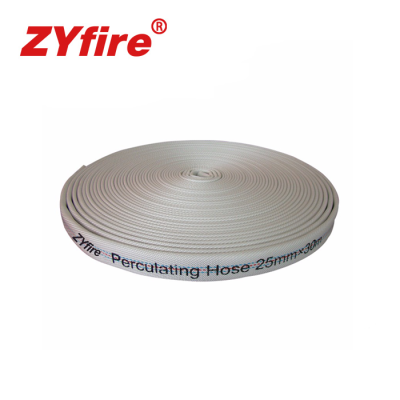
ZYfire's porous hose is made from recycled rubber and polyethylene, with millions of microscopic pores that ooze water evenly along the entire length. Unlike drip tape, it resists clogging because the pores are self-cleaning under pressure. The hose operates at low pressure (0.5–2 bar), reducing energy costs. For the Napa vineyard, switching to ZYfire porous hose eliminated dry spots and cut water usage by 30%, boosting yield by 12% in the first season.
For the Dutch dairy farm, the porous hose's wide internal diameter prevented blockages. Maintenance dropped to zero, and the hose lasted 8 years versus 2 for drip tape. The €12,000 replacement cost was avoided entirely.
In Alicante, the almond grower reduced evaporation to near zero by burying the hose 10 cm below the surface. Water savings of 40% allowed him to expand his orchard by 20% without exceeding his water quota.
Customer Success Stories
Case 1: Green Valley Vineyards, California
Owner: Maria Santos. Problem: Uneven irrigation caused 15% yield loss. Solution: ZYfire porous hose installed on 40 acres. Result: 30% water reduction, 12% yield increase, $18,000 annual savings. Quote: "ZYfire's hose turned our vineyard around. The consistency is remarkable."
Case 2: De Jong Dairy, Netherlands
Owner: Pieter de Jong. Problem: Drip tape clogging cost €12,000 every 2 years. Solution: ZYfire porous hose for 20 hectares. Result: No maintenance in 3 years, water savings of 25%, milk production stable. Quote: "Finally, a system that works without constant babysitting."
Case 3: Almendras del Sol, Spain
Owner: Carlos Ruiz. Problem: Evaporation losses of 35% under water restrictions. Solution: Buried ZYfire porous hose. Result: 40% water savings, expanded orchard by 20%, compliance with regulations. Quote: "ZYfire helped us grow more with less."
Case 4: Royal Botanic Gardens, UK
Head Gardener: Emma Thompson. Problem: Overhead watering damaged delicate plants. Solution: ZYfire porous hose for irrigation beds. Result: 50% water reduction, healthier specimens. Quote: "The precision is incredible."
Case 5: Wheat Farm, Australia
Owner: John Mitchell. Problem: Saline water clogged drip emitters. Solution: ZYfire porous hose with saline-resistant pores. Result: 20% higher yield, no clogging. Quote: "It handles our tough water conditions perfectly."
Applications and Partnerships
ZYfire porous hose is used in vineyards, orchards, row crops, greenhouses, and landscaping. Key partners include Bayer Crop Science and Netafim, who recommend ZYfire for precision irrigation. ZYfire has supplied to large buyers like John Deere and Rain Bird, ensuring global availability.
FAQ
Q1: How does porous hose prevent clogging?
Answer: The pores are designed with a conical shape that expands under pressure, allowing particles to pass through. Additionally, the hose material is treated with an antimicrobial coating to prevent biofilm growth.
Q2: What is the lifespan of ZYfire porous hose?
Answer: Typically 8–10 years under normal conditions, thanks to UV stabilizers and robust rubber construction. It can be repaired easily with couplings if damaged.
Q3: Can I use porous hose with saline water?
Answer: Yes. ZYfire offers a saline-resistant variant with larger pores and a hydrophobic lining to prevent salt buildup. It works well with water up to 3,000 ppm TDS.
Q4: How deep should I bury the hose?
Answer: For most crops, 10–15 cm below the soil surface is ideal. This reduces evaporation and keeps roots moist. In sandy soils, go deeper (20 cm) to avoid surface runoff.
Q5: What pressure is required?
Answer: The hose operates at 0.5–2 bar (7–29 psi). A simple pressure regulator is sufficient. Lower pressure reduces energy costs and prolongs pump life.
Conclusion
Porous hose irrigation from ZYfire Hose Corporation is not just a product—it's a solution to the inefficiencies plaguing modern agriculture. By delivering water evenly, reducing waste, and slashing maintenance, it pays for itself within one season. Don't let your irrigation system drain your resources. Download our technical white paper for detailed specs, or contact our sales engineers for a free system design. Visit ZYfire.com to start saving water and boosting yields today.
Related News
More >-
![Why Sexless Hose Couplings Are Revolutionizing High-Pressure Industrial Systems]()
Why Sexless Hose Couplings Are Revolutionizing High-Pressure Industrial Systems
1. Introduction: The Hidden Cost of Coupling Failures 2. Pain Points: Leakage, Maintenance Downtime, and Safety Hazards 3. Solution: How Sexless Hose Couplings Eliminate These Issues 4. Customer Success Stories 5. Applications and Partnerships 6. FAQ for Engineers and Procurement Managers 7. Conclusion and Call to Action
-
![Is 50 ft the Optimal Length for Fire Hose?]()
Is 50 ft the Optimal Length for Fire Hose?
1. Introduction: The 50 ft Fire Hose Question 2. Industry Pain Points: When 50 ft Falls Short 3. The Engineering Answer: Why 50 ft Works 4. Real-World Success: Case Studies 5. Applications and Partnerships 6. FAQ for Engineers and Procurement 7. Conclusion and Call to Action
-
![Is Your Key Combat Ready Hose Truly Ready?]()
Is Your Key Combat Ready Hose Truly Ready?
1. Introduction: The critical moment that tests your hose
2. Pain Point 1: Kinking and flow restriction under pressure
3. Pain Point 2: Abrasion and environmental degradation
4. Pain Point 3: Coupling failures and incompatible connections
5. Solutions: Engineering a truly combat ready hose
6. Customer Success Stories
7. Applications and Partnerships
8. FAQ for Engineers and Procurement Managers
9. Conclusion and Call to Action -
![Why 75 Foot Coiled Garden Hose Is a Game Changer?]()
Why 75 Foot Coiled Garden Hose Is a Game Changer?
-
![Why PE Hose Is the Hidden Hero of Industrial Safety?]()
Why PE Hose Is the Hidden Hero of Industrial Safety?
This article explores the critical role of PE hose in industrial applications, addressing common pain points, offering solutions, and showcasing real-world successes. It includes FAQs and a call to action for technical resources.
-
![Why 50 Foot Fire Hose Outperforms Shorter Lines?]()
Why 50 Foot Fire Hose Outperforms Shorter Lines?
A detailed technical blog exploring the critical role of 50-foot fire hose in industrial fire protection, addressing common pain points, solutions, real-world case studies, applications, FAQs, and a call to action for professional guidance.
-
![Why Choose ZYfire Hose for Chemical Industry?]()
Why Choose ZYfire Hose for Chemical Industry?
-
![Why Upgrade to a Manure Drag Hose for Sale?]()
Why Upgrade to a Manure Drag Hose for Sale?
Introduction: The pain of traditional manure application. Pain points: compaction, odor, nutrient loss. Solution: drag hose systems. Customer cases. Applications and partnerships. FAQ. Conclusion.
Get the latest price? We'll respond as soon as possible(within 12 hours)