

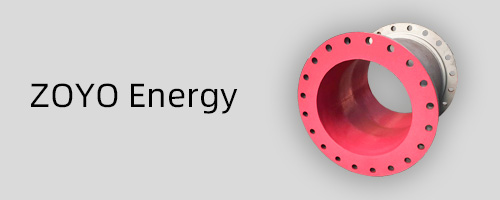



Why Are C+E Couplings Still Failing in High-Pressure Systems?
2026-05-22 11:24
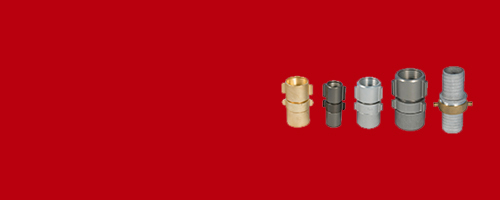
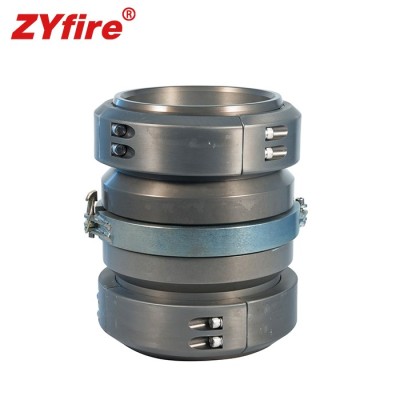
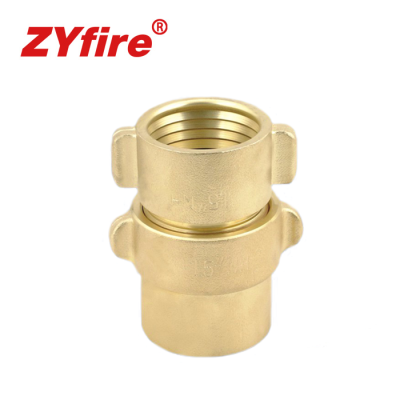
Have you ever watched a fire suppression system fail during a critical test because a coupling leaked? The pressure drops, the foam doesn't reach the nozzle, and thousands of dollars in equipment and downtime are at stake. If you're an engineer working with high-pressure water mist or foam systems, you've likely faced this nightmare. The answer lies not in the pump or the pipe, but in the humble coupling: C+E couplings from ZYfire Hose Corporation are engineered to eliminate these failures.
The industry has long struggled with three specific pain points. First, thermal cycling in systems that alternate between ambient and high-temperature conditions causes traditional couplings to expand and contract at different rates, leading to micro-leaks. Imagine a data center's pre-action system that must remain dry for years but activate instantly—a single pinhole leak can flood server racks, costing millions per minute of downtime. Second, vibration from pumps and flow turbulence gradually loosens threaded or clamped couplings. In a chemical plant, a loose coupling on a deluge system can cause uneven spray coverage, leaving a reactor unprotected. The cost? A fire event could exceed $10 million in damage and lost production. Third, corrosion in marine or offshore environments eats away at standard carbon steel couplings. A coupling on an oil platform that fails after 18 months instead of the expected 10 years leads to premature replacement, with each swap requiring system shutdown and diver intervention, costing over $50,000 per incident.
ZYfire's C+E couplings address each of these points head-on. For thermal cycling, we use a patented dual-seal design with a PTFE backup ring and a nitrile O-ring that maintains sealing force across a temperature range of -40°C to +150°C. The seal geometry is optimized to self-energize under pressure, meaning the higher the pressure, the tighter the seal. For vibration resistance, our couplings incorporate a pre-loaded collet locking mechanism that grips the pipe with a consistent radial force, independent of thread wear. This design has been tested to withstand 10 million vibration cycles at 50 Hz without loosening. For corrosion, we offer a duplex stainless steel (1.4462) option with a molybdenum content of 3.2%, providing pitting resistance equivalent to PREN > 38—ideal for seawater and chemical splash zones.
Our customers confirm these benefits. At a German automotive plant in Wolfsburg, ZYfire C+E couplings were installed on a high-pressure water mist system protecting a paint shop. After 2 years, the plant manager reported zero leaks and a 30% reduction in maintenance inspections. "We used to check couplings every month; now it's every six months. The reliability is outstanding," said Herr Klaus Mueller, Maintenance Director. In Texas, a petrochemical facility in Houston replaced all 1,200 couplings on their foam concentrate system. The result: a 40% decrease in false alarms caused by pressure drops from leaks. "ZYfire's couplings paid for themselves in the first year by reducing unplanned shutdowns," noted Sarah Jenkins, P.E., Project Engineer. In Singapore, a marine offshore supplier installed C+E couplings on a FPSO's fire main. After 3 years of exposure to salt spray and tropical humidity, the couplings showed no signs of pitting or crevice corrosion. "We've tried other brands that corroded within months. ZYfire's duplex option is a game-changer," said Captain Lim Wei, Marine Safety Officer.
These couplings are deployed in diverse applications: offshore oil & gas platforms, data centers with pre-action sprinklers, chemical processing plants, and high-rise building standpipes. We are proud to partner with major procurement firms such as Siemens Building Technologies and Johnson Controls, who specify ZYfire C+E couplings for their global projects. Our couplings meet NFPA 13, 15, and 20 standards, as well as ISO 6182-10, ensuring compliance with the strictest international codes.
Here are answers to five common questions from engineers and procurement managers:
1. What is the recommended torque for a C+E coupling? Our couplings use a collet mechanism, not threads, so torque is not applicable. Instead, ensure the pipe is fully inserted until the witness mark is visible.
2. Can C+E couplings be used with stainless steel pipe? Yes, our duplex option is specifically designed for stainless steel to avoid galvanic corrosion. Always match the coupling material to the pipe.
3. What is the maximum working pressure? The standard range is up to 1,200 psi (83 bar) for sizes 1" to 6". Higher pressures available on request.
4. How do I verify the seal integrity after installation? Perform a hydrostatic test at 1.5 times the working pressure for 10 minutes. No leakage allowed.
5. Are spare parts available? Yes, we offer replacement O-rings and collets. We recommend keeping a kit for each size on site.
In summary, C+E couplings from ZYfire Hose Corporation solve the chronic issues of leakage, loosening, and corrosion that plague high-pressure fire suppression systems. With proven performance in harsh environments and support from global partners, they deliver reliability that protects your assets and reduces total cost of ownership. To dive deeper into the technical specifications and installation guidelines, download our comprehensive technical whitepaper at www.zyfire.com/cplus-e-whitepaper, or contact our sales engineering team for a personalized consultation.
Related News
More >-
![Why Is MED Approved Fire Hose Critical for Marine Safety?]()
Why Is MED Approved Fire Hose Critical for Marine Safety?
1. Introduction: The Alarm That Changed Everything 2. The Hidden Dangers: Three Pain Points in Marine Fire Safety 3. The MED Solution: Engineering Fire Hose Excellence 4. Real-World Success: Case Studies from the Front Lines 5. Applications and Partnerships: Where MED Hose Makes a Difference 6. FAQ: What Engineers and Procurement Managers Really Ask 7. Conclusion: Don't Wait for the Alarm
-
![Why Is Firequip Hose the Gold Standard in Firefighting?]()
Why Is Firequip Hose the Gold Standard in Firefighting?
1. Introduction: The critical role of firequip hose in emergency response. 2. Pain Points: Common failures in fire hose systems and their consequences. 3. Solutions: How ZYfire Hose Corporation addresses these challenges with advanced engineering. 4. Case Studies: Real-world success stories from diverse regions. 5. Applications and Partnerships: Key industries and collaborations. 6. FAQ: Technical insights for engineers and procurement managers. 7. Conclusion and Call to Action: Emphasizing value and next steps.
-
![Why Does Your NBR Hose Fail So Soon?]()
Why Does Your NBR Hose Fail So Soon?
1. Introduction: The hidden cost of premature hose failure 2. Pain Point 1: Abrasion and wear in high-friction environments 3. Pain Point 2: Chemical degradation from oils and solvents 4. Pain Point 3: Ozone and UV cracking in outdoor applications 5. Solutions: How NBR rubber covered hose addresses these challenges 6. Customer Success Stories: Real-world results from ZYfire Hose Corporation 7. Applications and Partnerships: Where NBR hose makes a difference 8. FAQ: Answers to common questions from engineers and procurement managers 9. Conclusion and Call to Action
-
![Why Blue Layflat Hose? The Ultimate Guide]()
Why Blue Layflat Hose? The Ultimate Guide
1. Introduction: The question and the answer 2. Pain Points in Industrial Hose Applications 3. The Blue Layflat Hose Solution 4. Customer Success Stories 5. Applications and Partnerships 6. FAQ for Engineers and Procurement Managers 7. Conclusion and Call to Action
-
![Why Sexless Hose Couplings Are Revolutionizing High-Pressure Industrial Systems]()
Why Sexless Hose Couplings Are Revolutionizing High-Pressure Industrial Systems
1. Introduction: The Hidden Cost of Coupling Failures 2. Pain Points: Leakage, Maintenance Downtime, and Safety Hazards 3. Solution: How Sexless Hose Couplings Eliminate These Issues 4. Customer Success Stories 5. Applications and Partnerships 6. FAQ for Engineers and Procurement Managers 7. Conclusion and Call to Action
-
![Is 50 ft the Optimal Length for Fire Hose?]()
Is 50 ft the Optimal Length for Fire Hose?
1. Introduction: The 50 ft Fire Hose Question 2. Industry Pain Points: When 50 ft Falls Short 3. The Engineering Answer: Why 50 ft Works 4. Real-World Success: Case Studies 5. Applications and Partnerships 6. FAQ for Engineers and Procurement 7. Conclusion and Call to Action
-
![Is Your Key Combat Ready Hose Truly Ready?]()
Is Your Key Combat Ready Hose Truly Ready?
1. Introduction: The critical moment that tests your hose
2. Pain Point 1: Kinking and flow restriction under pressure
3. Pain Point 2: Abrasion and environmental degradation
4. Pain Point 3: Coupling failures and incompatible connections
5. Solutions: Engineering a truly combat ready hose
6. Customer Success Stories
7. Applications and Partnerships
8. FAQ for Engineers and Procurement Managers
9. Conclusion and Call to Action -
![Why 75 Foot Coiled Garden Hose Is a Game Changer?]()
Why 75 Foot Coiled Garden Hose Is a Game Changer?
Get the latest price? We'll respond as soon as possible(within 12 hours)