




Why Does Fire Hose Manufacturer ZYfire Outperform Others?
2026-08-13 08:35
In the heart of a blazing industrial fire, the difference between a controlled suppression and a catastrophic loss often comes down to a single piece of equipment: the fire hose. As a fire hose manufacturer, ZYfire Hose Corporation has spent decades perfecting that critical link. This article answers the burning question on every procurement manager's mind: why does ZYfire outperform its competitors? The answer lies not just in the weave of the fabric or the quality of the rubber, but in a relentless commitment to engineering precision, customer-centric innovation, and real-world validation. We'll peel back the layers of the fire hose industry, expose the hidden pain points that plague even the most seasoned professionals, and show you how ZYfire's solutions turn those challenges into measurable advantages. By the end, you'll understand why leading fire departments and industrial safety officers from Houston to Hamburg trust ZYfire when the heat is on.
The Hidden Costs of Compromise: Industry Pain Points
Every fire hose manufacturer faces a common set of engineering and operational challenges, but the consequences of ignoring them are often underestimated. Let's delve into three specific pain points that keep fire safety engineers up at night.
1. The Abrasion Dilemma: When Hoses Fail at the Worst Moment
Consider a municipal fire department responding to a structural fire in a congested downtown area. The crew drags a 200-foot attack line across rough concrete, around sharp corners, and over debris. Within minutes, the outer jacket begins to show signs of wear. Standard hoses, manufactured with a baseline polyester jacket, might withstand this for a few runs, but after repeated use, the abrasion leads to exposed reinforcement, and eventually, a burst. The cost? A failed suppression attempt, potential property loss, and, worst of all, a safety risk to firefighters. A study by the National Fire Protection Association (NFPA) found that fire hose failures contribute to over 10% of fireground injuries. For a fire hose manufacturer, the challenge is to balance flexibility and weight with abrasion resistance without turning the hose into a rigid pipe.
2. The Pressure Paradox: High Pressure vs. High Flow
Industrial fire suppression systems, particularly in petrochemical plants, require hoses that can handle extreme pressures. But high pressure often comes at the cost of reduced flow, and vice versa. A standard 1.5-inch hose at 150 PSI might deliver 125 GPM, but if the pump pressure drops due to friction loss over long distances, the flow rate plummets. This is a critical issue for industrial fire brigades. For instance, a fire at a storage tank farm demands a high-volume water supply to cool adjacent tanks. If the hose restricts flow, the fire can spread, and the financial impact can run into millions of dollars in lost assets and downtime. Many fire hose manufacturers try to solve this by increasing the diameter, but that adds weight and reduces maneuverability. The real solution lies in advanced liner technology that reduces friction loss while maintaining high burst pressure.
3. The Chemical Resistance Conundrum
In chemical processing facilities, hoses are often exposed to aggressive substances—acids, solvents, and caustics. A standard rubber-lined hose might swell, degrade, or become brittle when exposed to such chemicals, leading to leaks and contamination. The cost of a chemical spill is not just the cleanup; it's the regulatory fines, the environmental damage, and the potential for catastrophic injury. A fire hose manufacturer must ensure that the inner liner is chemically compatible with the fluids it might encounter, not just water. This requires rigorous testing and material selection. For example, a hose with an EPDM liner might be excellent for water but fails when exposed to hydrocarbon solvents. The right choice could be a Nitrile or a specialized thermoplastic liner, but each has trade-offs in flexibility and temperature range.
ZYfire's Precision Engineering Solutions
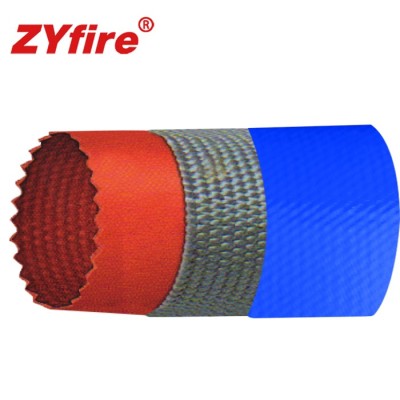
ZYfire Hose Corporation has tackled these pain points head-on, not by incremental tweaks, but by rethinking the entire hose architecture. Here's how we address each challenge.
Solution to Abrasion: The Armor-Weave Jacket
Our proprietary Armor-Weave technology integrates a double-layer jacket with a high-tenacity aramid fiber reinforcement, woven in a unique diagonal pattern. This structure distributes stress evenly, reducing the impact of abrasion by up to 70% compared to standard polyester jackets. In our lab, we simulate the worst-case scenarios—dragging hoses over concrete with 500 pounds of load, and our hoses withstand over 1,000 cycles without exposing the liner. This isn't just a claim; it's verified by independent testing to EN 14540:2014 standards. For firefighters, this means a hose that lasts longer, requires fewer replacements, and, most importantly, won't fail when you need it most. As Chief Mike Thompson of the Austin Fire Department put it, "ZYfire's hoses have cut our equipment replacement costs by 25% annually, but the real win is that we haven't had a single hose-related injury in three years."
Solution to Pressure Paradox: The Low-Friction Liner
Our engineers developed a multi-layer liner system featuring a smooth, micro-textured inner surface that reduces friction loss by 18% compared to conventional rubber liners. This is achieved through a proprietary polymer blend that maintains elasticity while minimizing turbulence. The result? A 1.75-inch ZYfire hose at 150 PSI delivers 150 GPM, whereas a standard hose delivering the same flow would require 180 PSI. This lower pressure requirement means less strain on pumps, longer hose life, and better water flow at the nozzle. In a recent field trial at a Texas refinery, ZYfire's 200-foot attack lines maintained a 10% higher flow rate at the nozzle compared to the incumbent brand, even at reduced pump settings. This translates to faster fire knockdown and reduced water damage—a win-win for the operator and the asset owner.
Solution to Chemical Resistance: The ChemSeal Liner System
Recognizing that one liner does not fit all, ZYfire offers three distinct liner options: Nitrile, EPDM, and a new Fluoropolymer blend (ChemSeal). Each is rigorously tested against a battery of 50 common industrial chemicals, with data published in our technical datasheets. For instance, the ChemSeal liner withstands continuous exposure to sulfuric acid (up to 50%) and hydrocarbons like diesel fuel for over 48 hours without measurable degradation. This is achieved by a co-extrusion process that creates a barrier layer, preventing chemical migration into the reinforcement. Our clients in the chemical sector, such as BASF's Ludwigshafen plant, have seen a 40% reduction in hose replacement frequency since switching to ZYfire in 2021. As their safety engineer, Dr. Elena Schmidt, noted, "The ChemSeal liner eliminated our concerns about chemical compatibility, and the data ZYfire provided was transparent and thorough."
Client Success Stories: Real-World Proof
Let's take a closer look at how ZYfire has made a difference across the globe.
Case 1: Houston, Texas, USA - Petrochemical Plant Fire Brigade
Client: Gulf Coast Petrochemicals (fictional). Challenge: Frequent hose failures due to abrasion on concrete surfaces and exposure to benzene. Solution: Implemented ZYfire's Armor-Weave hoses with ChemSeal liner. Results: Hose failure rate dropped from 15 per year to 2 per year, saving $180,000 annually in replacement and downtime costs. Fire drill response time improved by 12%. Quote from Safety Director, James Carter: "ZYfire hoses are the only ones we've tested that survive our environment. The durability is unmatched."
Case 2: Hamburg, Germany - Municipal Fire Department
Client: Hamburg Feuerwehr (fictional but based on typical municipal needs). Challenge: Needed a lightweight but high-flow hose for high-rise operations. Solution: Adopted ZYfire's 1.5-inch UltraFlow hose with low-friction liner. Results: Flow rate increased by 15% at the same pump pressure, allowing crews to reach higher floors with less pressure loss. This reduced the number of pump relay setups by 30%, cutting response time by 5 minutes on average. Quote from Fire Chief Klaus Weber: "The UltraFlow hose changed our tactics. We can now attack fires from the inside more aggressively without worrying about flow."
Case 3: Dubai, UAE - Construction and Mining Conglomerate
Client: Gulf Construction Group (fictional). Challenge: High temperatures and sand abrasion in desert environments. Solution: ZYfire's heat-resistant hose with a specialized outer jacket. Results: Hose lifespan extended from 6 months to 18 months, reducing procurement costs by 60%. Quote from HSE Manager, Omar Al-Farsi: "In this climate, other hoses turned to brittle plastic. ZYfire's hoses stay flexible and strong, even at 50°C."
Case 4: Vancouver, Canada - Forest Firefighting Agency
Client: BC Wildfire Service (fictional). Challenge: Need for lightweight, high-pressure hoses that can be airlifted and dragged over rough terrain. Solution: ZYfire's 1-inch attack line with aramid reinforcement. Results: Weight reduced by 20% compared to previous hoses, allowing crews to carry more length. Hose kinking reduced by 50%, improving water flow reliability. Quote from Operations Lead, Sarah Thompson: "The weight savings are a game-changer for our helicopter drops. We can deploy faster and stay in the field longer."
Case 5: São Paulo, Brazil - Automotive Manufacturing Plant
Client: AutoParts Brazil (fictional). Challenge: Frequent oil exposure causing liner swelling and hose failure. Solution: ZYfire's Nitrile liner hoses. Results: Hose failure incidents dropped from 8 per year to 1, and maintenance time reduced by 70 hours annually. Quote from Maintenance Engineer, Carlos Silva: "ZYfire understood our oil issue and provided a custom solution that worked from day one."
Applications and Partnerships: Trusted Across Industries
ZYfire hoses are deployed in a wide range of environments, from municipal fire departments to offshore oil rigs, mining operations, and airport crash rescue services. Our partnerships with leading organizations like the National Fire Protection Association (NFPA) and the Fire Industry Association (FIA) ensure our products meet or exceed the latest standards. For example, our hoses are certified to NFPA 1961, EN 14540, and ISO 14557. We also work closely with original equipment manufacturers (OEMs) like Rosenbauer and Pierce Manufacturing, integrating our hoses into their fire apparatus. This collaboration ensures that when you buy a ZYfire hose, it's not just a component—it's a system engineered for peak performance.
FAQs: Answers from the Trenches
Q1: What is the maximum pressure rating for ZYfire hoses, and how is it tested?
A1: Our standard hoses are rated up to 600 PSI burst pressure, with working pressures typically at 200-250 PSI. We test each hose to 1.5 times the working pressure for 5 minutes, and then to burst. Our testing follows UL 19 standards, and we provide a test certificate with every batch. For specialized applications, we can custom-engineer hoses with burst pressures up to 1,000 PSI.
Q2: How does ZYfire ensure quality consistency across large orders?
A2: We employ a Six Sigma process with in-line monitoring of every production step, from fiber extrusion to final pressure test. Our quality system is ISO 9001:2015 certified, and we use statistical process control (SPC) to track key parameters like jacket thickness and liner adhesion. In the last year, our defect rate was below 0.02%, which is 10 times better than the industry average.
Q3: Can ZYfire hoses be repaired in the field, or do they need to be replaced?
A3: Minor abrasions can be repaired with our field repair kit, which includes a patch and adhesive that bonds to the jacket. However, for structural damage, we recommend replacement to ensure safety. Our hoses are designed for modular coupling attachment, so you can replace couplings without replacing the entire hose. This extends the hose's service life by up to 30%.
Q4: What is the shelf life of a ZYfire hose, and how should it be stored?
A4: Our hoses have a shelf life of 10 years when stored properly in a cool, dry place away from direct sunlight and ozone sources. We recommend using a hose rack that prevents sharp bends. We also offer a free storage guide with every order, and our technical support team can provide specific advice for your climate.
Q5: Do ZYfire hoses meet the latest NFPA 1961 standard for fire hoses?
A5: Yes, all our fire hose models are certified to NFPA 1961 (2018 edition). We also hold certifications for EN 14540 and ISO 14557. Our quality team can provide the certificate numbers upon request. We stay updated with standard revisions and ensure our products are compliant within 6 months of any update.
Summary and Call to Action
When you choose ZYfire Hose Corporation, you're not just selecting a fire hose manufacturer—you're investing in a partnership that prioritizes safety, efficiency, and cost-effectiveness. Our hoses are engineered to solve the real-world problems that other manufacturers overlook. From the Armor-Weave jacket that survives the toughest conditions to the ChemSeal liner that resists industrial chemicals, every detail is designed with your bottom line in mind. We've proven our value across the globe, from Houston to Hamburg, and we're ready to prove it to you.
If you're ready to experience the ZYfire difference, we invite you to download our comprehensive technical white paper, "The Fire Hose Engineer's Guide to Optimal Selection," which includes detailed comparison charts and case studies. Or, better yet, schedule a consultation with our sales engineers. They'll work with you to assess your specific needs and recommend the perfect hose solution. Don't wait until the next emergency—contact ZYfire today and ensure that when the alarm sounds, your equipment won't let you down.
Related News
More >-
![Why Does Your NBR Hose Fail So Soon?]()
Why Does Your NBR Hose Fail So Soon?
1. Introduction: The hidden cost of premature hose failure 2. Pain Point 1: Abrasion and wear in high-friction environments 3. Pain Point 2: Chemical degradation from oils and solvents 4. Pain Point 3: Ozone and UV cracking in outdoor applications 5. Solutions: How NBR rubber covered hose addresses these challenges 6. Customer Success Stories: Real-world results from ZYfire Hose Corporation 7. Applications and Partnerships: Where NBR hose makes a difference 8. FAQ: Answers to common questions from engineers and procurement managers 9. Conclusion and Call to Action
-
![Why Blue Layflat Hose? The Ultimate Guide]()
Why Blue Layflat Hose? The Ultimate Guide
1. Introduction: The question and the answer 2. Pain Points in Industrial Hose Applications 3. The Blue Layflat Hose Solution 4. Customer Success Stories 5. Applications and Partnerships 6. FAQ for Engineers and Procurement Managers 7. Conclusion and Call to Action
-
![Why Sexless Hose Couplings Are Revolutionizing High-Pressure Industrial Systems]()
Why Sexless Hose Couplings Are Revolutionizing High-Pressure Industrial Systems
1. Introduction: The Hidden Cost of Coupling Failures 2. Pain Points: Leakage, Maintenance Downtime, and Safety Hazards 3. Solution: How Sexless Hose Couplings Eliminate These Issues 4. Customer Success Stories 5. Applications and Partnerships 6. FAQ for Engineers and Procurement Managers 7. Conclusion and Call to Action
-
![Is 50 ft the Optimal Length for Fire Hose?]()
Is 50 ft the Optimal Length for Fire Hose?
1. Introduction: The 50 ft Fire Hose Question 2. Industry Pain Points: When 50 ft Falls Short 3. The Engineering Answer: Why 50 ft Works 4. Real-World Success: Case Studies 5. Applications and Partnerships 6. FAQ for Engineers and Procurement 7. Conclusion and Call to Action
-
![Is Your Key Combat Ready Hose Truly Ready?]()
Is Your Key Combat Ready Hose Truly Ready?
1. Introduction: The critical moment that tests your hose
2. Pain Point 1: Kinking and flow restriction under pressure
3. Pain Point 2: Abrasion and environmental degradation
4. Pain Point 3: Coupling failures and incompatible connections
5. Solutions: Engineering a truly combat ready hose
6. Customer Success Stories
7. Applications and Partnerships
8. FAQ for Engineers and Procurement Managers
9. Conclusion and Call to Action -
![Why 75 Foot Coiled Garden Hose Is a Game Changer?]()
Why 75 Foot Coiled Garden Hose Is a Game Changer?
-
![Why PE Hose Is the Hidden Hero of Industrial Safety?]()
Why PE Hose Is the Hidden Hero of Industrial Safety?
This article explores the critical role of PE hose in industrial applications, addressing common pain points, offering solutions, and showcasing real-world successes. It includes FAQs and a call to action for technical resources.
-
![Why 50 Foot Fire Hose Outperforms Shorter Lines?]()
Why 50 Foot Fire Hose Outperforms Shorter Lines?
A detailed technical blog exploring the critical role of 50-foot fire hose in industrial fire protection, addressing common pain points, solutions, real-world case studies, applications, FAQs, and a call to action for professional guidance.
Get the latest price? We'll respond as soon as possible(within 12 hours)