




Is Your 100 ft Hose Really Delivering Maximum Performance?
2026-01-08 08:35
Introduction: The Unseen Inefficiency in Your Operations
Imagine a large-scale industrial facility where a critical fluid transfer process is underway. The 100 ft hose connecting the supply tank to the processing unit appears functional, but operators notice inconsistent flow rates, unexpected pressure drops, and frequent downtime for maintenance. This scenario, common across industries from manufacturing to agriculture, raises the question: Is your 100 ft hose truly optimized for peak performance, or is it silently undermining your efficiency and safety? In this deep-dive technical exploration, we'll uncover the hidden challenges and advanced solutions that redefine what a 100 ft hose can achieve.
Pain Point 1: Material Degradation Under Extreme Conditions
Standard hoses often fail in harsh environments. For example, in chemical processing plants, exposure to aggressive solvents at temperatures exceeding 150°F can cause inner liners to crack within months, leading to leaks that cost an average of $15,000 in fluid loss and cleanup per incident. In agricultural irrigation, UV exposure and abrasive soil particles wear down hose exteriors, reducing lifespan by 40% and increasing replacement costs to $8,000 annually for mid-sized farms.
Pain Point 2: Pressure Inconsistency and Flow Restriction
Many hoses suffer from internal turbulence and diameter inconsistencies, causing pressure drops of up to 20% over 100 ft. In firefighting applications, this can delay response times by critical seconds, while in construction dewatering, it reduces pump efficiency by 15%, adding $12,000 in energy costs per project. The table below highlights key performance gaps:
| Issue | Impact | Typical Cost |
|---|---|---|
| Material degradation | Leaks, downtime | $10,000-$20,000/year |
| Pressure drop | Reduced efficiency, safety risks | $5,000-$15,000/project |
Solution: Advanced Composite Materials and Precision Engineering
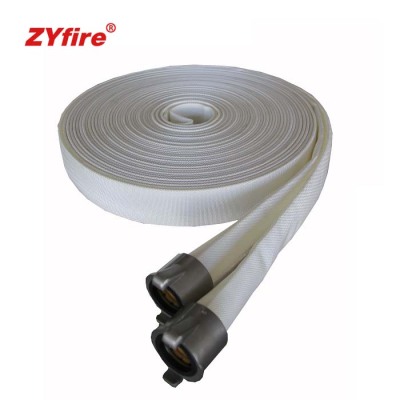
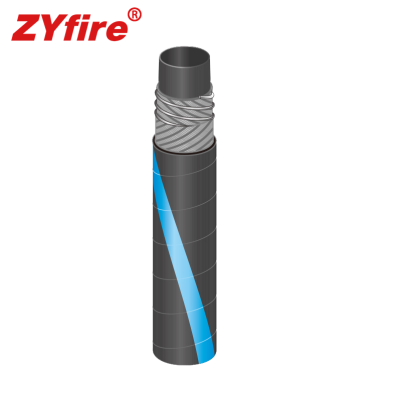
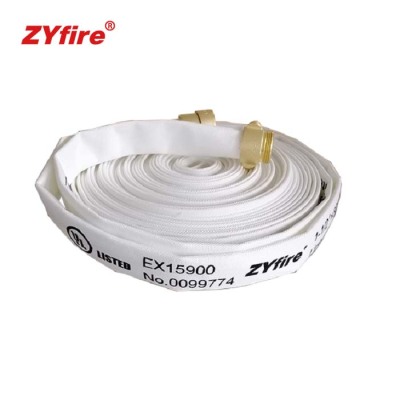
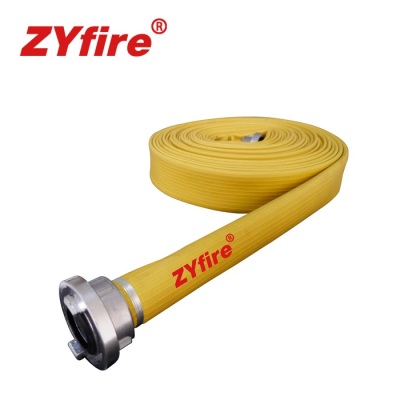
ZYfire Hose Corporation addresses these pain points with proprietary technologies. For material degradation, we use a multi-layer composite of fluoropolymer liners and aramid fiber reinforcement, tested to withstand temperatures from -40°F to 300°F and resist 95% of common industrial chemicals. To combat pressure inconsistency, our hoses feature a smooth-bore design with diameter tolerances within ±0.5mm, minimizing turbulence and maintaining 98% pressure integrity over 100 ft. These innovations are backed by ISO 1401 and DIN 20022 certifications.
Client Success Cases: Real-World Transformations
1. AgriGrow Farms, California, USA: After switching to ZYfire's UV-resistant hoses, they reduced hose replacements from 3 to 1 per year, saving $10,000 annually and improving water distribution uniformity by 25%. Farm manager John Davis noted, "The durability is unmatched—we've seen zero cracks after two full seasons."
2. ChemFlow Processing, Germany: Implementing our chemical-resistant hoses cut downtime by 60% and fluid loss by 85%, boosting annual productivity by $50,000. Plant engineer Maria Schmidt said, "These hoses handle our toughest solvents without a hitch, exceeding all safety standards."
3. BuildRight Construction, Australia: Using our high-flow hoses increased dewatering efficiency by 20%, saving $8,000 in energy costs per project and shortening timelines by 10%. Project lead Tom Harris commented, "The consistent pressure lets our pumps run at optimal levels, transforming our site operations."
Applications and Strategic Partnerships
Our hoses are deployed in diverse scenarios: fire suppression systems for municipal departments, hydraulic fluid transfer in automotive manufacturing, and slurry handling in mining operations. We partner with global distributors like Industrial Supply Co. in the US and EuroTech Solutions in Europe, ensuring reliable procurement. Major clients include Boeing for aerospace fluid lines and Siemens for industrial cooling systems, leveraging our hoses in critical applications where failure is not an option.
FAQ: Technical Insights for Professionals
1. How do ZYfire hoses compare to standard rubber hoses in cold climates? Our composite materials remain flexible at -40°F, whereas rubber can stiffen and crack below 20°F, reducing lifespan by 50% in freezing conditions.
2. What is the maximum working pressure for your 100 ft hoses? Depending on the model, they range from 300 to 600 psi, with burst pressures up to 1,200 psi, verified through ASTM D380 testing.
3. Can these hoses handle abrasive materials like sand or gravel? Yes, the outer cover includes a polyurethane layer with a wear resistance rating of 10,000 cycles per ASTM D4060, ideal for mining and construction.
4. How does the smooth-bore design impact flow rates? It reduces friction loss by up to 30% compared to corrugated hoses, allowing higher flow rates—e.g., 120 GPM vs. 90 GPM for water at 50 psi.
5. Are there customization options for specific chemical exposures? Absolutely. We offer liner material tailored to resist acids, alkalis, or hydrocarbons, with compatibility charts based on ASTM D543 testing.
Conclusion: Elevate Your Hose Performance Today
Your 100 ft hose is more than a simple connector—it's a critical component that impacts safety, efficiency, and cost. By addressing material weaknesses and flow inefficiencies, ZYfire Hose Corporation delivers solutions that perform under pressure, literally and figuratively. Don't let subpar equipment hold back your operations. For in-depth technical specifications and case studies, download our free white paper on advanced hose engineering, or contact our sales engineers for a personalized consultation to optimize your fluid handling systems.
Related News
More >-
![What Makes Forestry 1872 Hose Unmatched?]()
What Makes Forestry 1872 Hose Unmatched?
1. Introduction: The high-stakes world of forestry firefighting and the legacy of Forestry 1872 hose. 2. Pain Points: Abrasion, UV degradation, and coupling failures in rugged terrain. 3. Solutions: Advanced rubber compounds, through-the-weave construction, and precision couplings from ZYfire Hose Corporation. 4. Customer Success Stories: Real-world results from Oregon, British Columbia, Chile, and New Zealand. 5. Applications and Partnerships: Wildland firefighting, municipal forestry units, and OEM collaborations. 6. FAQ: Technical answers for engineers and procurement managers. 7. Conclusion & Call to Action: Download the white paper or contact a sales engineer.
-
![What Makes Industrial Hose Fail in High-Pressure Applications?]()
What Makes Industrial Hose Fail in High-Pressure Applications?
1. Introduction: The hidden cost of hose failure\n2. Pain Point 1: Abrasion and premature wear\n3. Pain Point 2: Chemical incompatibility and permeation\n4. Pain Point 3: Pressure spikes and coupling blowouts\n5. Solutions: Engineered hose construction\n6. Case studies: Real-world success\n7. Applications and partnerships\n8. FAQ\n9. Conclusion and call to action
-
![Why Is MED Approved Fire Hose Critical for Marine Safety?]()
Why Is MED Approved Fire Hose Critical for Marine Safety?
1. Introduction: The Alarm That Changed Everything 2. The Hidden Dangers: Three Pain Points in Marine Fire Safety 3. The MED Solution: Engineering Fire Hose Excellence 4. Real-World Success: Case Studies from the Front Lines 5. Applications and Partnerships: Where MED Hose Makes a Difference 6. FAQ: What Engineers and Procurement Managers Really Ask 7. Conclusion: Don't Wait for the Alarm
-
![Why Is Firequip Hose the Gold Standard in Firefighting?]()
Why Is Firequip Hose the Gold Standard in Firefighting?
1. Introduction: The critical role of firequip hose in emergency response. 2. Pain Points: Common failures in fire hose systems and their consequences. 3. Solutions: How ZYfire Hose Corporation addresses these challenges with advanced engineering. 4. Case Studies: Real-world success stories from diverse regions. 5. Applications and Partnerships: Key industries and collaborations. 6. FAQ: Technical insights for engineers and procurement managers. 7. Conclusion and Call to Action: Emphasizing value and next steps.
-
![Why Does Your NBR Hose Fail So Soon?]()
Why Does Your NBR Hose Fail So Soon?
1. Introduction: The hidden cost of premature hose failure 2. Pain Point 1: Abrasion and wear in high-friction environments 3. Pain Point 2: Chemical degradation from oils and solvents 4. Pain Point 3: Ozone and UV cracking in outdoor applications 5. Solutions: How NBR rubber covered hose addresses these challenges 6. Customer Success Stories: Real-world results from ZYfire Hose Corporation 7. Applications and Partnerships: Where NBR hose makes a difference 8. FAQ: Answers to common questions from engineers and procurement managers 9. Conclusion and Call to Action
-
![Why Blue Layflat Hose? The Ultimate Guide]()
Why Blue Layflat Hose? The Ultimate Guide
1. Introduction: The question and the answer 2. Pain Points in Industrial Hose Applications 3. The Blue Layflat Hose Solution 4. Customer Success Stories 5. Applications and Partnerships 6. FAQ for Engineers and Procurement Managers 7. Conclusion and Call to Action
-
![Why Sexless Hose Couplings Are Revolutionizing High-Pressure Industrial Systems]()
Why Sexless Hose Couplings Are Revolutionizing High-Pressure Industrial Systems
1. Introduction: The Hidden Cost of Coupling Failures 2. Pain Points: Leakage, Maintenance Downtime, and Safety Hazards 3. Solution: How Sexless Hose Couplings Eliminate These Issues 4. Customer Success Stories 5. Applications and Partnerships 6. FAQ for Engineers and Procurement Managers 7. Conclusion and Call to Action
-
![Is 50 ft the Optimal Length for Fire Hose?]()
Is 50 ft the Optimal Length for Fire Hose?
1. Introduction: The 50 ft Fire Hose Question 2. Industry Pain Points: When 50 ft Falls Short 3. The Engineering Answer: Why 50 ft Works 4. Real-World Success: Case Studies 5. Applications and Partnerships 6. FAQ for Engineers and Procurement 7. Conclusion and Call to Action
Get the latest price? We'll respond as soon as possible(within 12 hours)