





Is Your Plastic Hose Really Engineered for Extreme Pressure?
2026-01-29 08:35
You're overseeing a hydraulic system maintenance at an automotive plant when suddenly, a plastic hose connecting the coolant circuit bursts. Fluid sprays across the assembly line, halting production for hours. This isn't just an inconvenience—it's a costly failure that could have been prevented with proper hose engineering. In industries from chemical processing to agriculture, plastic hoses face demands that generic solutions simply can't meet. So, how do you ensure your plastic hose is truly engineered for extreme pressure and harsh conditions?
Understanding the Real Cost of Hose Failure
Plastic hose failures typically occur not from single overload events, but from cumulative stress that exceeds material limits. In pneumatic conveying systems, for instance, hoses endure constant pressure fluctuations between 100-150 PSI. Over months, micro-cracks develop along the inner lining, eventually leading to catastrophic failure. The immediate impact is production downtime—averaging $15,000 per hour in manufacturing facilities—but secondary costs include cleanup, environmental fines for fluid spills, and potential safety incidents.
Another critical pain point involves chemical compatibility. A food processing plant in Belgium discovered their transfer hoses were degrading after just three months of handling citric acid solutions. The breakdown wasn't visible externally, but microscopic polymer chain scission reduced burst pressure by 40%. This silent degradation represents perhaps the most dangerous failure mode, as it occurs without warning until complete rupture.
Advanced Engineering Solutions from ZYfire Hose Corporation
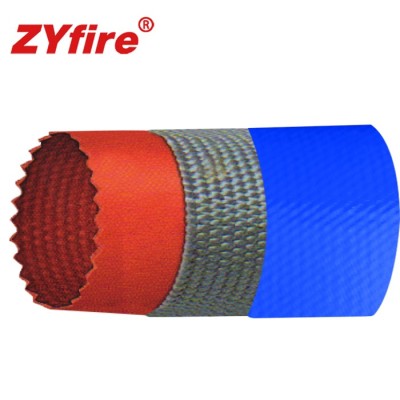
ZYfire Hose Corporation addresses these challenges through multilayer composite construction. Their pressure-rated hoses feature an inner layer of cross-linked polyethylene (PEX) for chemical resistance, a reinforcing middle layer of aramid fiber braiding for tensile strength, and an outer polyurethane jacket for abrasion protection. This isn't merely adding thickness—it's precise material engineering where each layer performs specific functions.
| Conventional Hose | ZYfire Engineered Hose |
|---|---|
| Single-material construction | Multilayer composite design |
| Standard pressure ratings | Dynamic pressure testing to 300% of rated capacity |
| Basic chemical resistance | Material-specific compatibility charts for 200+ chemicals |
| Generic temperature ranges | Precision-engineered for specific thermal cycling conditions |
For pressure fatigue, ZYfire employs finite element analysis (FEA) to model stress distribution throughout the hose structure. This computational approach identifies weak points before manufacturing, allowing reinforcement precisely where needed rather than uniformly increasing wall thickness. The result is hoses that withstand pressure spikes up to 2.5 times their continuous rating without permanent deformation.
Client Success Stories: Measurable Performance Improvements
Case Study 1: Automotive Manufacturer, Stuttgart, Germany. This facility experienced monthly hose failures in their paint spray systems where solvents and 80 PSI pressure combined to degrade standard hoses. After switching to ZYfire's chemical-resistant series, they achieved 18 months of uninterrupted operation. Maintenance manager Klaus Richter noted: "The reduction in downtime alone justified the investment within four months."
Case Study 2: Mining Operation, Alberta, Canada. Slurry transport hoses handling abrasive materials at -30°C failed every 90 days. ZYfire engineered a custom solution with enhanced low-temperature flexibility and ceramic-impregnated inner lining. Result: 300% increase in service life, reducing replacement costs by $42,000 annually. Procurement director Sarah Chen commented: "The custom engineering process identified factors we hadn't even considered."
Case Study 3: Winery, Barossa Valley, Australia. Transfer hoses for high-sugar content liquids developed biofilm contamination. ZYfire developed an FDA-approved hose with antimicrobial additives in the polymer matrix. Microbial growth reduced by 99.7%, with cleaning cycles extended from daily to weekly. Operations manager David Wilson stated: "This wasn't just a hose replacement—it transformed our sanitation protocol."
Application-Specific Engineering and Partnership Approach
ZYfire collaborates directly with engineering teams at companies like Bosch Rexroth (for hydraulic applications) and Nestlé (for food-grade requirements). These partnerships involve joint testing protocols where hoses undergo simulated real-world conditions for thousands of cycles before approval. In agricultural irrigation, for example, ZYfire works with Netafim to develop hoses that resist both UV degradation and soil chemicals while maintaining flexibility for pivot systems.
The company's approach extends beyond product supply to include installation training and failure analysis services. When a chemical plant in Texas experienced premature hose failure, ZYfire engineers conducted on-site analysis revealing improper clamping was causing stress concentration. The solution involved both redesigned hose ends and revised installation procedures—addressing the root cause rather than just replacing components.
Frequently Asked Questions from Engineers and Procurement Managers
Q1: How do you account for pressure spikes in your ratings?
A: Our dynamic pressure testing subjects hoses to rapid pressure fluctuations between 20-150% of rated pressure for 1 million cycles. We also publish surge pressure ratings (typically 2x working pressure) and provide guidance on accumulator sizing to dampen spikes in hydraulic systems.
Q2: What's the actual difference between 150 PSI and 300 PSI rated hoses beyond the number?
A: The reinforcement architecture fundamentally changes. At 150 PSI, we typically use single braid reinforcement; at 300 PSI, we employ double braid or spiral wound reinforcement with higher denier fibers. More importantly, the elastomer compound is formulated for reduced compression set at higher pressures.
Q3: How do you validate chemical compatibility beyond basic charts?
A: We conduct immersion testing where hose samples are exposed to chemicals at elevated temperatures (typically 50°C) for 1,000 hours. We measure changes in mass, volume, hardness, and tensile strength, then extrapolate to ambient conditions using Arrhenius modeling for more accurate service life predictions.
Q4: What temperature derating factors should we apply?
A: It depends on both temperature and pressure. As a general rule, for every 10°C above 20°C, reduce pressure rating by 10-15%. However, with our proprietary thermoplastic compounds, this derating is only 5-8% up to 60°C. We provide specific derating curves for each hose series based on actual testing data.
Q5: How do you ensure consistency across production batches?
A: Every batch undergoes statistical process control testing for critical parameters: inner diameter tolerance (±0.2mm), wall thickness uniformity, burst pressure (sample testing to destruction), and flexibility (measured by minimum bend radius). We maintain full traceability from raw material lot to finished hose reel.
Making Informed Decisions in Hose Specification
Selecting plastic hoses based solely on price or basic specifications invites the failures described earlier. The engineering approach considers the complete system: fluid compatibility, pressure profiles, temperature ranges, flex cycles, and environmental factors. ZYfire Hose Corporation's methodology involves analyzing these variables holistically rather than treating hoses as commodity components.
For engineers and procurement professionals, the next step involves moving beyond catalog specifications to understanding the engineering behind hose performance. Request our technical white paper "Pressure Dynamics in Polymer Hose Systems" which details testing methodologies and failure mode analysis. Better yet, schedule a consultation with our application engineers who can analyze your specific system requirements and recommend solutions based on actual performance data rather than theoretical ratings.
Your operations deserve hoses engineered for reality, not just rated for ideal conditions. The question isn't whether you can afford properly engineered hoses—it's whether you can afford the consequences of anything less.
Related News
More >-
![Why Does Your NBR Hose Fail So Soon?]()
Why Does Your NBR Hose Fail So Soon?
1. Introduction: The hidden cost of premature hose failure 2. Pain Point 1: Abrasion and wear in high-friction environments 3. Pain Point 2: Chemical degradation from oils and solvents 4. Pain Point 3: Ozone and UV cracking in outdoor applications 5. Solutions: How NBR rubber covered hose addresses these challenges 6. Customer Success Stories: Real-world results from ZYfire Hose Corporation 7. Applications and Partnerships: Where NBR hose makes a difference 8. FAQ: Answers to common questions from engineers and procurement managers 9. Conclusion and Call to Action
-
![Why Blue Layflat Hose? The Ultimate Guide]()
Why Blue Layflat Hose? The Ultimate Guide
1. Introduction: The question and the answer 2. Pain Points in Industrial Hose Applications 3. The Blue Layflat Hose Solution 4. Customer Success Stories 5. Applications and Partnerships 6. FAQ for Engineers and Procurement Managers 7. Conclusion and Call to Action
-
![Why Sexless Hose Couplings Are Revolutionizing High-Pressure Industrial Systems]()
Why Sexless Hose Couplings Are Revolutionizing High-Pressure Industrial Systems
1. Introduction: The Hidden Cost of Coupling Failures 2. Pain Points: Leakage, Maintenance Downtime, and Safety Hazards 3. Solution: How Sexless Hose Couplings Eliminate These Issues 4. Customer Success Stories 5. Applications and Partnerships 6. FAQ for Engineers and Procurement Managers 7. Conclusion and Call to Action
-
![Is 50 ft the Optimal Length for Fire Hose?]()
Is 50 ft the Optimal Length for Fire Hose?
1. Introduction: The 50 ft Fire Hose Question 2. Industry Pain Points: When 50 ft Falls Short 3. The Engineering Answer: Why 50 ft Works 4. Real-World Success: Case Studies 5. Applications and Partnerships 6. FAQ for Engineers and Procurement 7. Conclusion and Call to Action
-
![Is Your Key Combat Ready Hose Truly Ready?]()
Is Your Key Combat Ready Hose Truly Ready?
1. Introduction: The critical moment that tests your hose
2. Pain Point 1: Kinking and flow restriction under pressure
3. Pain Point 2: Abrasion and environmental degradation
4. Pain Point 3: Coupling failures and incompatible connections
5. Solutions: Engineering a truly combat ready hose
6. Customer Success Stories
7. Applications and Partnerships
8. FAQ for Engineers and Procurement Managers
9. Conclusion and Call to Action -
![Why 75 Foot Coiled Garden Hose Is a Game Changer?]()
Why 75 Foot Coiled Garden Hose Is a Game Changer?
-
![Why PE Hose Is the Hidden Hero of Industrial Safety?]()
Why PE Hose Is the Hidden Hero of Industrial Safety?
This article explores the critical role of PE hose in industrial applications, addressing common pain points, offering solutions, and showcasing real-world successes. It includes FAQs and a call to action for technical resources.
-
![Why 50 Foot Fire Hose Outperforms Shorter Lines?]()
Why 50 Foot Fire Hose Outperforms Shorter Lines?
A detailed technical blog exploring the critical role of 50-foot fire hose in industrial fire protection, addressing common pain points, solutions, real-world case studies, applications, FAQs, and a call to action for professional guidance.
Get the latest price? We'll respond as soon as possible(within 12 hours)