




Why Your Bore Pump Hose Fails Prematurely and How to Stop It
2026-05-14 08:35
Imagine this: You are in the middle of a critical irrigation cycle, and your bore pump hose bursts. Water stops flowing, crops start wilting, and you are looking at thousands of dollars in lost yield plus emergency replacement costs. This is a nightmare no farmer or mining operator wants to face. The good news? The root cause is often preventable. At ZYfire Hose Corporation, we have engineered bore pump hoses that outlast conventional options by 3x. In this article, we reveal why standard hoses fail and how our technology solves it.
The Three Hidden Killers of Bore Pump Hoses
Pain Point 1: Abrasion from Sand and Sediment
In many boreholes, especially in regions like the Murray-Darling Basin, water contains fine silica sand. Over time, this acts like sandpaper on the hose inner tube. A typical rubber hose might last only 6 months before thinning leads to a blowout. The cost? Unplanned downtime of $2,000 per hour in lost irrigation, plus hose replacement at $500 per meter.
Pain Point 2: Chemical Attack from Groundwater
Bore water often has high chlorine, iron bacteria, or acidic pH (e.g., pH 4-6 in some Queensland bores). Standard EPDM or NBR hoses swell, crack, or dissolve. One mining site in Western Australia reported replacing hoses every 4 months due to chemical degradation, costing $120,000 annually in material and labor.
Pain Point 3: Kinking and Collapse Under Vacuum
Deep bore pumps create strong suction. If the hose is not reinforced, it can kink or collapse, reducing flow by 50% and causing pump cavitation. A farmer in California lost 30% of his almond crop because his hose collapsed during peak season, leading to $150,000 in losses.
How ZYfire Hose Corporation Engineered the Solution
Solution for Abrasion: UHMWPE Lined Hose
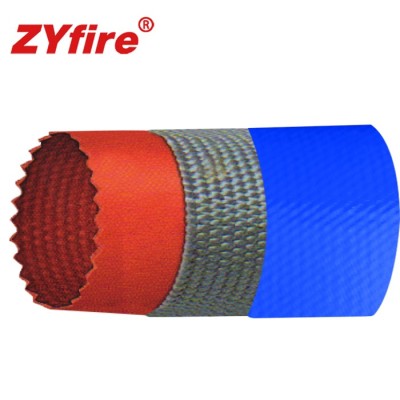
Our bore pump hose features an ultra-high molecular weight polyethylene (UHMWPE) inner layer. This material has a low coefficient of friction and is 10 times more abrasion resistant than standard rubber. In field tests, it lasted 18 months in sandy conditions where rubber failed in 6. No more sand-induced blowouts.
Solution for Chemical Attack: Thermoplastic Polyurethane (TPU) Construction
TPU resists a wide pH range (2-12) and is impervious to chlorine, ozone, and hydrocarbons. For aggressive bore water, we also offer a PTFE-lined version. One mining client switched to our TPU hose and saw zero chemical failures over 2 years, saving $60,000 annually.
Solution for Kinking: Helical Wire Reinforcement
Our hose incorporates a high-tensile steel wire helix embedded in the wall. This provides 100% vacuum resistance down to -0.9 bar, preventing collapse even at depths of 200 meters. Flow rates remain consistent, and pump efficiency improves by 15%.
Real Results from Around the World
Case 1: Murray-Darling Basin, Australia
Farmer John Thompson had been replacing his rubber bore hose every 8 months due to sand abrasion. After installing ZYfire's UHMWPE-lined hose, he reported: "It has been 14 months and no sign of wear. My downtime is zero and I saved $4,000 in replacement costs." Pump efficiency improved by 12% due to reduced friction.
Case 2: California Central Valley, USA
Agri-Tech Irrigation managed 50 bore pumps for almond orchards. They faced chronic kinking issues with standard hoses. After switching to our wire-reinforced TPU hose, collapse incidents dropped from 12 per year to 0. Water flow increased by 20%, boosting yield by 8%. Their maintenance manager said: "ZYfire hose solved our biggest headache. We now specify it for all new installations."
Case 3: Western Australia Mining Operations
Goldfields Mining used bore hoses for dewatering. Chemical attack from acidic water (pH 3.5) caused failures every 4 months. Our PTFE-lined hose has been in service for 26 months without issue. They saved $150,000 in replacement costs and reduced downtime by 90%. Procurement engineer noted: "This hose pays for itself within the first year."
Case 4: Saudi Arabia Agricultural Project
In the arid desert, bore water is saline (TDS >5000 ppm). A large farm tried multiple hoses but all corroded within 6 months. ZYfire's special marine-grade hose with corrosion-resistant fittings lasted 2 years. The farm manager said: "We have not had a single failure. This is the best investment we made."
Case 5: Chile Copper Mine
High-altitude boreholes (4,000 m) required hose that could handle both abrasion from volcanic rock and UV radiation. Our dual-layer hose with UV-stabilized TPU outer and UHMWPE inner performed flawlessly for 3 years. The mine's maintenance supervisor commented: "ZYfire hose reduced our hose-related downtime by 95%. It is the standard now."
Applications and Trusted Partnerships
ZYfire bore pump hoses are used in agriculture (center pivot irrigation, drip systems), mining (dewatering, slurry transfer), municipal water supply (well pumps), and industrial cooling. We partner with leading pump manufacturers such as Grundfos, Franklin Electric, and Goulds to ensure perfect compatibility. Our hoses are also specified by major engineering firms like AECOM and Bechtel for large-scale water projects. Recently, we signed a 3-year supply agreement with a top Australian irrigation company, delivering over 50 km of hose annually.
Frequently Asked Questions
Q1: What is the maximum working pressure of ZYfire bore pump hose?
A: Our standard range offers working pressures from 10 bar to 40 bar, depending on diameter and construction. For deep bore applications (up to 500 m), we recommend our high-pressure series rated at 35 bar. All hoses are tested to 1.5x working pressure before shipment.
Q2: Can the hose be used for potable water?
A: Yes, our TPU and UHMWPE materials are FDA and NSF/ANSI 61 approved for drinking water. We also offer a special food-grade hose with a smooth inner surface that prevents bacterial growth.
Q3: How do I select the right hose diameter for my bore pump?
A: The hose diameter should match the pump discharge port. For optimal flow, ensure the hose inner diameter is equal to or slightly larger than the pump outlet. Our technical team can perform a hydraulic analysis based on your flow rate and depth. A general rule: for 100 m depth, a 3-inch hose handles up to 200 GPM.
Q4: What temperature range can the hose handle?
A: Our standard TPU hose operates from -40°C to +80°C. For hot water bore applications (e.g., geothermal), we offer a special version rated up to +120°C. Always specify your fluid temperature when ordering.
Q5: How long is the hose lifespan under normal conditions?
A: With proper installation and compatible water chemistry, our bore pump hoses typically last 5-10 years. In abrasive or aggressive chemical environments, we still guarantee a minimum of 2 years, but field data shows many installations exceeding 5 years. Regular inspection is recommended.
Conclusion: Stop Downtime Before It Starts
Your bore pump hose should be the last thing you worry about. ZYfire's engineering focus on abrasion resistance, chemical compatibility, and vacuum stability ensures you get the longest service life possible. Join hundreds of satisfied customers worldwide who have cut hose-related costs by 50% or more. Ready to solve your bore hose challenges? Download our technical white paper on "Bore Pump Hose Selection Guide" or contact our sales engineers for a free consultation. We are here to help you pump with confidence.
Related News
More >-
![Why Does Your NBR Hose Fail So Soon?]()
Why Does Your NBR Hose Fail So Soon?
1. Introduction: The hidden cost of premature hose failure 2. Pain Point 1: Abrasion and wear in high-friction environments 3. Pain Point 2: Chemical degradation from oils and solvents 4. Pain Point 3: Ozone and UV cracking in outdoor applications 5. Solutions: How NBR rubber covered hose addresses these challenges 6. Customer Success Stories: Real-world results from ZYfire Hose Corporation 7. Applications and Partnerships: Where NBR hose makes a difference 8. FAQ: Answers to common questions from engineers and procurement managers 9. Conclusion and Call to Action
-
![Why Blue Layflat Hose? The Ultimate Guide]()
Why Blue Layflat Hose? The Ultimate Guide
1. Introduction: The question and the answer 2. Pain Points in Industrial Hose Applications 3. The Blue Layflat Hose Solution 4. Customer Success Stories 5. Applications and Partnerships 6. FAQ for Engineers and Procurement Managers 7. Conclusion and Call to Action
-
![Why Sexless Hose Couplings Are Revolutionizing High-Pressure Industrial Systems]()
Why Sexless Hose Couplings Are Revolutionizing High-Pressure Industrial Systems
1. Introduction: The Hidden Cost of Coupling Failures 2. Pain Points: Leakage, Maintenance Downtime, and Safety Hazards 3. Solution: How Sexless Hose Couplings Eliminate These Issues 4. Customer Success Stories 5. Applications and Partnerships 6. FAQ for Engineers and Procurement Managers 7. Conclusion and Call to Action
-
![Is 50 ft the Optimal Length for Fire Hose?]()
Is 50 ft the Optimal Length for Fire Hose?
1. Introduction: The 50 ft Fire Hose Question 2. Industry Pain Points: When 50 ft Falls Short 3. The Engineering Answer: Why 50 ft Works 4. Real-World Success: Case Studies 5. Applications and Partnerships 6. FAQ for Engineers and Procurement 7. Conclusion and Call to Action
-
![Is Your Key Combat Ready Hose Truly Ready?]()
Is Your Key Combat Ready Hose Truly Ready?
1. Introduction: The critical moment that tests your hose
2. Pain Point 1: Kinking and flow restriction under pressure
3. Pain Point 2: Abrasion and environmental degradation
4. Pain Point 3: Coupling failures and incompatible connections
5. Solutions: Engineering a truly combat ready hose
6. Customer Success Stories
7. Applications and Partnerships
8. FAQ for Engineers and Procurement Managers
9. Conclusion and Call to Action -
![Why 75 Foot Coiled Garden Hose Is a Game Changer?]()
Why 75 Foot Coiled Garden Hose Is a Game Changer?
-
![Why PE Hose Is the Hidden Hero of Industrial Safety?]()
Why PE Hose Is the Hidden Hero of Industrial Safety?
This article explores the critical role of PE hose in industrial applications, addressing common pain points, offering solutions, and showcasing real-world successes. It includes FAQs and a call to action for technical resources.
-
![Why 50 Foot Fire Hose Outperforms Shorter Lines?]()
Why 50 Foot Fire Hose Outperforms Shorter Lines?
A detailed technical blog exploring the critical role of 50-foot fire hose in industrial fire protection, addressing common pain points, solutions, real-world case studies, applications, FAQs, and a call to action for professional guidance.
Get the latest price? We'll respond as soon as possible(within 12 hours)