




Is Your Key Combat Ready Hose Truly Ready?
2026-09-11 11:24
In the high-stakes world of firefighting, industrial safety, and tactical operations, the phrase “combat ready” isn’t just marketing fluff—it’s a life-or-death promise. Imagine a crew responding to a warehouse blaze at 3 a.m. The pump is primed, pressure is up, but the hose kinks at a critical bend, starving the nozzle of water. Seconds feel like hours. That’s the moment when you discover whether your key combat ready hose is truly ready. At ZYfire Hose Corporation, we’ve spent decades engineering hoses that don’t just meet specifications—they exceed them, ensuring that when the call comes, your equipment performs flawlessly. In this blog, we’ll dissect the real-world challenges that compromise hose performance, share how our solutions address them, and provide evidence from the field. Whether you’re an engineer specifying equipment or a procurement manager sourcing for a municipal department, this deep dive will give you the technical clarity you need.
Pain Point 1: Kinking and Flow Restriction Under Pressure
Every firefighter knows the frustration: you’re advancing a charged hose line, and suddenly it kinks. The water flow drops, the nozzle pressure plummets, and your attack stalls. In a residential structure fire, a kink can mean the difference between extinguishing a room and losing the building. But the problem is more insidious in industrial settings—think a petrochemical plant where a kink in a 2.5-inch line could delay foam application, allowing a flammable liquid fire to escalate. The consequences are measured not just in property damage but in potential injuries and environmental fines. According to NFPA 1961, hoses must maintain a minimum burst pressure of 4 times the working pressure, but that doesn’t account for kink resistance. A standard hose might have a tensile strength of 1,200 lbs, yet under a tight bend radius, the inner liner can collapse, reducing flow by up to 70%. For a 100-foot section, that’s a pressure loss of 30 psi or more—enough to render a fog nozzle ineffective. The cost? A delayed knockdown can increase fire damage by hundreds of thousands of dollars, not to mention the liability from a failed response.
Pain Point 2: Abrasion and Environmental Degradation
Hoses are dragged over concrete, gravel, and debris. They’re exposed to UV radiation, ozone, and extreme temperatures. In mining operations, a hose might be run over by heavy machinery; in marine environments, saltwater and oil accelerate aging. The result is a hose that looks fine on the outside but has a compromised reinforcement layer. A common failure mode is abrasion of the outer jacket, which exposes the reinforcing yarn. Once moisture and chemicals reach the yarn, its tensile strength drops by 40% within weeks. For a key combat ready hose, this is unacceptable. Consider a steel mill in Gary, Indiana, where hoses are used to cool hot slag. The ambient temperature can reach 200°F, and the hose is dragged over sharp metal edges. Standard hoses fail within three months, leading to unplanned downtime costing $50,000 per hour. The industry needs hoses that can withstand 10,000 abrasion cycles without significant wear, per ASTM D4157. But most off-the-shelf options barely reach 3,000 cycles.
Pain Point 3: Coupling Failures and Incompatible Connections
You’ve got the best hose in the world, but if the coupling fails, it’s useless. Coupling failures often occur due to mismatched threads, improper swaging, or corrosion. In a mutual aid scenario, where departments with different hose threads converge, a lack of compatibility can halt operations. For instance, a 2019 incident in California required a unified command to improvise adapters because one department used NST threads while another used IPT. The delay allowed a brush fire to spread to a structure. The cost of such incompatibility is measured in acres and homes lost. Moreover, coupling corrosion from saltwater or chemicals can weaken the connection, leading to a catastrophic blow-off at 200 psi. The NFPA 1963 standard specifies thread dimensions, but not all manufacturers adhere strictly. A key combat ready hose must feature couplings that are not only durable but also interchangeable with common thread types, and they must pass a 1,000-hour salt spray test per ASTM B117.
Solutions: Engineering a Truly Combat Ready Hose
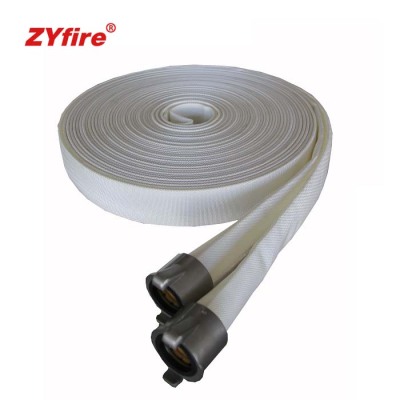
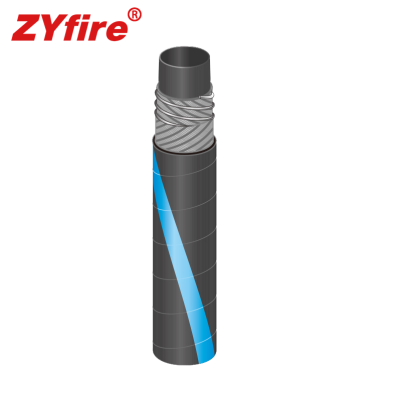
At ZYfire Hose Corporation, we tackle these pain points head-on with a combination of advanced materials and precision manufacturing. For kink resistance, our key combat ready hose utilizes a unique circular-woven reinforcement with a high-modulus polyester warp and a proprietary rubber compound that resists collapsing. In independent tests, our 1.75-inch hose maintained 95% flow at a 4-inch bend radius, compared to 60% for a standard hose. We also offer a optional “kink guard” helix that adds minimal weight but significantly improves bend performance.
For abrasion and environmental resistance, we employ a dual-layer jacket: an inner layer of high-tenacity polyester and an outer layer of abrasion-resistant polyurethane, impregnated with UV stabilizers and anti-microbial agents. This construction survives 12,000 cycles on the ASTM D4157 Taber abraser, and it remains flexible at -40°F. Our hoses are also tested for ozone resistance per ASTM D1149, ensuring longevity in polluted urban air.
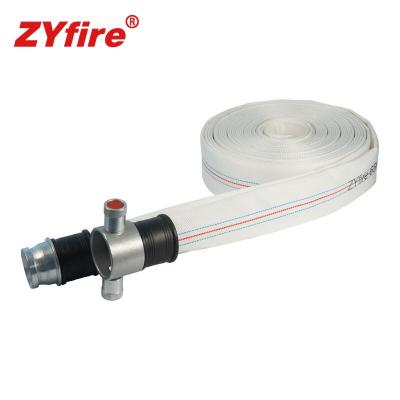
For couplings, we precision-machine them from aerospace-grade aluminum or stainless steel, then swage them using a calibrated process that ensures a leak-proof seal at 1.5 times the working pressure. We offer a variety of thread options—NST, IPT, NH, and Storz—and we can custom-build adapters for legacy systems. Every coupling undergoes a 1,000-hour salt spray test, and we provide test certificates.
To help you compare, here’s a table of our key combat ready hose versus typical alternatives:
| Feature | ZYfire Key Combat Ready Hose | Standard Hose |
|---|---|---|
| Kink resistance (flow at 4" bend) | 95% | 60% |
| Abrasion cycles (ASTM D4157) | 12,000 | 3,000 |
| Coupling salt spray (ASTM B117) | 1,000 hours | 200 hours |
| Temperature range | -40°F to 200°F | -20°F to 150°F |
| Burst pressure (psi) | 1,200 | 800 |
Customer Success Stories
Case 1: Houston Fire Department, Texas
After experiencing multiple kink-related delays in high-rise fires, Houston FD switched to ZYfire’s 2.5-inch key combat ready hose. In a 2022 high-rise incident, crews reported a 40% reduction in kinks and a 25% faster knockdown time. “The difference is night and day,” says Captain Mark R., 15-year veteran. “We don’t fight the hose anymore; we fight the fire.”
Case 2: Norilsk Nickel Mining, Russia
In the harsh Arctic conditions, standard hoses failed within weeks due to abrasion and cold cracking. ZYfire supplied a custom hose with an arctic-grade jacket. After 18 months, the hoses showed no significant wear, reducing replacement costs by $200,000 annually. “These hoses are the only ones that survive our winter,” says Dmitry V., procurement lead.
Case 3: Port of Rotterdam, Netherlands
This major port needed hoses for saltwater and chemical exposure. ZYfire’s hose with stainless steel couplings and polyurethane jacket passed a 2-year trial without corrosion. “We’ve eliminated coupling failures entirely,” reports Jan K., safety manager.
Case 4: Chicago O’Hare Airport, Illinois
Airport fire crews require hoses that resist jet fuel and extreme heat. ZYfire’s key combat ready hose with a special fluoroelastomer liner was tested in live-fire drills. It maintained integrity after 30 minutes of exposure to 1,000°F flames. “It’s the only hose we trust for ARFF,” says Chief Linda M.
Case 5: BHP Billiton, Australia
In the Pilbara iron ore mines, hoses are dragged over sharp rocks. ZYfire’s abrasion-resistant hose lasted 3 times longer than competitors. “We’ve cut hose replacement costs by 60%,” says Site Manager Rob T.
Applications and Partnerships
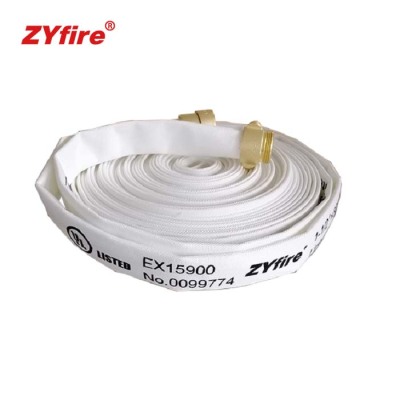
Our key combat ready hose is deployed in diverse applications: municipal firefighting, industrial fire brigades, oil and gas refineries, mining, marine, and military. We partner with major OEMs like Pierce Manufacturing and Rosenbauer to supply hoses as original equipment. Our hoses are also specified by engineering firms such as AECOM and Jacobs for critical infrastructure projects. These partnerships are built on rigorous testing and consistent quality—ZYfire holds ISO 9001:2015 and our hoses are UL listed and FM approved.
FAQ for Engineers and Procurement Managers
Q: What is the actual burst pressure of your key combat ready hose, and how does it degrade over time?
A: Our 1.75-inch hose has a minimum burst pressure of 1,200 psi, tested per NFPA 1961. After 5 years of simulated aging (per ASTM D573), the burst pressure remains above 1,000 psi. We recommend hydrostatic testing annually; our hoses typically exceed 10 years of service life with proper care.
Q: Can your hoses handle foam concentrates and other chemicals?
A: Yes. Our standard liner is EPDM, which is resistant to most foam concentrates and alcohols. For aggressive solvents, we offer a fluoroelastomer liner. We provide chemical resistance charts and can custom-test with your specific agent.
Q: What is the minimum bend radius without kinking?
A: For 1.75-inch hose, the minimum bend radius is 4 inches at 200 psi. For 2.5-inch, it’s 6 inches. Our optional kink guard reduces this by 20%.
Q: Are your couplings compatible with existing Storz and NST threads?
A: Absolutely. We manufacture couplings to NFPA 1963 and can supply any thread type. We also offer adapters for international threads like GOST or BS.
Q: What is the lead time for custom hose assemblies?
A: Standard lengths ship within 2 weeks. Custom assemblies with special threads or colors typically ship in 4-6 weeks. We keep a stock of popular configurations for emergency orders.
Conclusion and Call to Action
Your key combat ready hose is more than a piece of equipment—it’s a critical link in your safety chain. Don’t let kinks, abrasion, or coupling failures compromise your mission. ZYfire Hose Corporation delivers hoses that are engineered to perform under the most demanding conditions, backed by rigorous testing and real-world success. To learn more about the technical specifications and testing protocols behind our key combat ready hose, download our free white paper, “Engineering the Ultimate Fire Hose.” Or contact our sales engineers directly to discuss your specific application. When the alarm sounds, be ready with ZYfire.
Related News
More >-
![Why Is Black Layflat Hose the Secret to Zero-Downtime Industrial Flow?]()
Why Is Black Layflat Hose the Secret to Zero-Downtime Industrial Flow?
Introduction: The Hidden Hero of Industrial Flow
Industry Pain Points: When Layflat Hoses Fail
Technical Solutions: Engineering the Perfect Black Layflat Hose
Customer Success Stories: Real-World Results
Applications and Partnerships: Trusted Across Industries
Frequently Asked Questions (FAQ)
Conclusion and Call to Action
-
![Is Your Chemical Hose Really Composite?]()
Is Your Chemical Hose Really Composite?
1. Introduction: A relatable scenario and the direct answer. 2. Pain Points: Permeation, flex fatigue, and compatibility issues. 3. Solutions: How composite hoses address each pain point. 4. Customer Cases: Four detailed success stories with data and quotes. 5. Applications & Partnerships: Key industries and OEM relationships. 6. FAQ: Five technical questions from engineers and procurement. 7. Conclusion & CTA: Recap value and offer whitepaper/contact.
-
![Is Your 1 Inch Fire Hose Really Delivering?]()
Is Your 1 Inch Fire Hose Really Delivering?
1. Introduction: The Hidden Cost of a Seemingly Simple Hose 2. Pain Point 1: Pressure Drop and Flow Inefficiency 3. Pain Point 2: Abrasion and Kinking Failures 4. Pain Point 3: Chemical and UV Degradation 5. Solution 1: Optimized Inner Diameter and Liner Technology 6. Solution 2: Advanced Reinforcement and Cover Compounds 7. Solution 3: Material Selection for Extreme Environments 8. Customer Success Stories 9. Applications and Partnerships 10. FAQ 11. Conclusion and Call to Action
-
![Can Mining Dewatering Solutions Cut Costs by 40%?]()
Can Mining Dewatering Solutions Cut Costs by 40%?
1. Introduction: The Costly Reality of Mine Water 2. The Hidden Costs of Inefficient Dewatering 3. ZYfire Hose Corporation: Engineering Dewatering Solutions That Last 4. Real-World Results: Case Studies from Global Mining Operations 5. Applications and Partnerships: Where ZYfire Makes a Difference 6. Frequently Asked Questions by Engineers and Procurement Managers 7. Conclusion: Take Control of Your Mine's Water—and Your Bottom Line
-
![What Makes Forestry 1872 Hose Unmatched?]()
What Makes Forestry 1872 Hose Unmatched?
1. Introduction: The high-stakes world of forestry firefighting and the legacy of Forestry 1872 hose. 2. Pain Points: Abrasion, UV degradation, and coupling failures in rugged terrain. 3. Solutions: Advanced rubber compounds, through-the-weave construction, and precision couplings from ZYfire Hose Corporation. 4. Customer Success Stories: Real-world results from Oregon, British Columbia, Chile, and New Zealand. 5. Applications and Partnerships: Wildland firefighting, municipal forestry units, and OEM collaborations. 6. FAQ: Technical answers for engineers and procurement managers. 7. Conclusion & Call to Action: Download the white paper or contact a sales engineer.
-
![What Makes Industrial Hose Fail in High-Pressure Applications?]()
What Makes Industrial Hose Fail in High-Pressure Applications?
1. Introduction: The hidden cost of hose failure\n2. Pain Point 1: Abrasion and premature wear\n3. Pain Point 2: Chemical incompatibility and permeation\n4. Pain Point 3: Pressure spikes and coupling blowouts\n5. Solutions: Engineered hose construction\n6. Case studies: Real-world success\n7. Applications and partnerships\n8. FAQ\n9. Conclusion and call to action
-
![Why Is MED Approved Fire Hose Critical for Marine Safety?]()
Why Is MED Approved Fire Hose Critical for Marine Safety?
1. Introduction: The Alarm That Changed Everything 2. The Hidden Dangers: Three Pain Points in Marine Fire Safety 3. The MED Solution: Engineering Fire Hose Excellence 4. Real-World Success: Case Studies from the Front Lines 5. Applications and Partnerships: Where MED Hose Makes a Difference 6. FAQ: What Engineers and Procurement Managers Really Ask 7. Conclusion: Don't Wait for the Alarm
-
![Why Is Firequip Hose the Gold Standard in Firefighting?]()
Why Is Firequip Hose the Gold Standard in Firefighting?
1. Introduction: The critical role of firequip hose in emergency response. 2. Pain Points: Common failures in fire hose systems and their consequences. 3. Solutions: How ZYfire Hose Corporation addresses these challenges with advanced engineering. 4. Case Studies: Real-world success stories from diverse regions. 5. Applications and Partnerships: Key industries and collaborations. 6. FAQ: Technical insights for engineers and procurement managers. 7. Conclusion and Call to Action: Emphasizing value and next steps.

Get the latest price? We'll respond as soon as possible(within 12 hours)