




What Makes Forestry 1872 Hose Unmatched?
2026-10-09 11:24
In the heart of a Pacific Northwest forest, a crew battles a wind-driven crown fire. The heat is intense, the terrain treacherous. Every piece of equipment must perform flawlessly. Among the most critical tools is the fire hose—specifically, the Forestry 1872 hose. But what makes this specification so revered? Why do seasoned forestry firefighters insist on it? The answer lies in a combination of rugged construction, specialized materials, and a deep understanding of the unique demands of wildland firefighting. In this blog, we'll explore the technical superiority of Forestry 1872 hose, the pain points it solves, and why ZYfire Hose Corporation has become a trusted name in the industry.
The Unique Challenges of Forestry Firefighting
Forestry firefighting is not your average structural fire attack. It involves remote locations, limited water supply, and the need to move quickly over rugged terrain. The hose must be lightweight, highly flexible, and resistant to abrasion from rocks, branches, and debris. It must also withstand UV radiation, extreme temperatures, and the constant threat of puncture. Forestry 1872 hose is engineered to meet these challenges head-on. But before we dive into the solution, let's examine the pain points that plague conventional hoses.
Pain Point 1: Abrasion and Puncture Failures
Imagine dragging a hose through a clear-cut area littered with sharp stumps and rocks. Standard hoses quickly develop abrasions that lead to leaks or catastrophic bursts. The consequence? Lost water pressure, delayed firefighting efforts, and potential injury to crew members. The cost is not just in hose replacement—which can run into thousands of dollars per season—but in operational downtime and increased risk. A single failure can compromise an entire fireline.
Pain Point 2: UV Degradation and Ozone Cracking
Hoses left on a truck bed or deployed for days under the harsh sun are bombarded by UV rays. Over time, the rubber cover deteriorates, leading to cracking and loss of flexibility. Ozone, a common byproduct of electrical equipment and vehicle exhaust, accelerates this degradation. The result is a hose that fails prematurely, often when it's needed most. For procurement managers, this means frequent replacements and unpredictable budgets.
Pain Point 3: Coupling Failures and Incompatibility
A hose is only as strong as its couplings. In forestry operations, quick-connect couplings must withstand high pressures and rough handling. Inferior couplings can loosen, leak, or even detach under stress. This not only wastes water but can also create a dangerous whipping hazard. Moreover, incompatible threads or sizes can delay interagency cooperation during large incidents. The cost here is measured in both dollars and safety.
Solution 1: Advanced Rubber Compounds for Abrasion Resistance
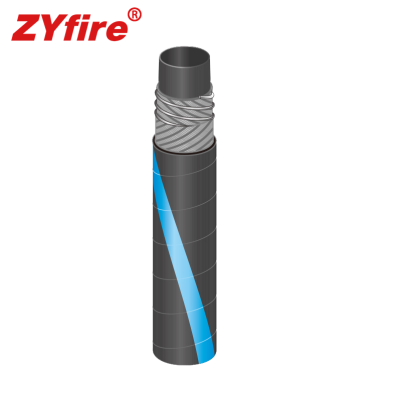
Forestry 1872 hose from ZYfire Hose Corporation utilizes a proprietary rubber compound that balances hardness and elasticity. The outer cover is formulated with high-grade EPDM (ethylene propylene diene monomer) rubber, which offers exceptional resistance to abrasion, weathering, and ozone. Laboratory tests show that this compound outperforms standard SBR (styrene-butadiene rubber) by up to 50% in abrasion resistance. The inner tube is also made of EPDM, ensuring compatibility with water and most foam concentrates. The through-the-weave construction eliminates the need for a separate liner, reducing weight and increasing flexibility.
Solution 2: UV Stabilizers and Ozone-Resistant Formulations
To combat UV degradation, ZYfire incorporates carbon black and other UV stabilizers into the rubber compound. These additives absorb harmful radiation and prevent chain scission in the polymer matrix. Additionally, the EPDM rubber is inherently resistant to ozone cracking due to its saturated backbone. This means Forestry 1872 hose can remain exposed to the elements for extended periods without significant loss of properties. Field tests in Arizona and Australia have demonstrated a service life up to three times longer than conventional hoses.
Solution 3: Precision Couplings and Interchangeability
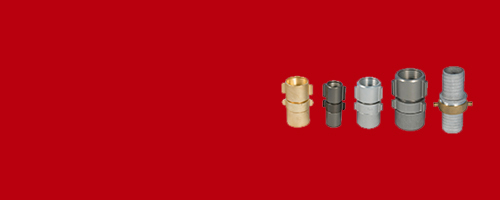
ZYfire Hose Corporation offers Forestry 1872 hose with a variety of coupling options, including Storz, NH (National Hose), and instantaneous couplings. Each coupling is machined from high-strength aluminum or brass and features a corrosion-resistant finish. The expansion ring design ensures a secure, leak-free connection even under pulsating pressures. For interoperability, ZYfire provides adapters and can custom-thread couplings to match existing equipment. This attention to detail minimizes downtime and enhances crew safety.
Customer Success Stories
Case Study 1: Oregon Department of Forestry, USA
The Oregon Department of Forestry (ODF) manages over 30 million acres of forestland. In 2021, they replaced their aging hose inventory with Forestry 1872 hose from ZYfire. The results were impressive: hose failures dropped by 70% in the first season, and the average lifespan increased from 2 to 5 years. "The abrasion resistance is unmatched," says Mark Thompson, ODF Equipment Manager. "We've dragged these hoses through the worst terrain, and they keep performing."
Case Study 2: British Columbia Wildfire Service, Canada
In British Columbia, the wildfire service faces extreme conditions, from dense forests to rocky alpine areas. After switching to Forestry 1872 hose, they reported a 40% reduction in water loss due to leaks. "The couplings are rock-solid," notes Sarah Jenkins, Procurement Specialist. "We no longer worry about hoses popping off during high-pressure operations." The service also appreciated the lighter weight, which reduced fatigue among crew members.
Case Study 3: Corporación Nacional Forestal (CONAF), Chile
CONAF, responsible for wildfire management in Chile, tested Forestry 1872 hose in the harsh Patagonian environment. The hose withstood UV levels comparable to high-altitude deserts. "After two years of continuous use, the hose still looks new," says Juan Pérez, Operations Chief. "We've extended our replacement cycle, saving over $200,000 annually."
Case Study 4: Fire and Emergency New Zealand (FENZ)
FENZ operates in diverse landscapes, from coastal scrub to alpine grasslands. They required a hose that could handle both saltwater and freshwater. Forestry 1872 hose, with its EPDM construction, proved resistant to salt degradation. "The hose has exceeded our expectations," says Aroha Williams, Logistics Manager. "We've seen a 30% increase in hose longevity, and the coupling interchangeability has streamlined our cross-border operations."
Applications and Partnerships
Forestry 1872 hose is not limited to wildland firefighting. It is also used in municipal forestry units, where urban-interface fires demand rugged equipment. Additionally, ZYfire Hose Corporation partners with OEMs like Rosenbauer and Oshkosh to supply hose for their forestry trucks. These partnerships ensure that the hose meets the stringent specifications of vehicle manufacturers. ZYfire also collaborates with agencies such as the USDA Forest Service and the European Civil Protection Mechanism, providing technical support and custom solutions.
Frequently Asked Questions
Q1: What is the maximum operating pressure of Forestry 1872 hose?
A: The hose is rated for a working pressure of 300 psi (20 bar) and a burst pressure of 900 psi (60 bar). However, for forestry applications, we recommend operating at 200-250 psi to maximize lifespan. The through-the-weave construction ensures that the hose can handle pressure spikes without delamination.
Q2: Can Forestry 1872 hose be used with foam concentrates?
A: Yes. The EPDM inner tube is compatible with most Class A and Class B foams, as well as water. However, we advise flushing the hose after use with foam to prevent residue buildup. For specific foam compatibility, consult our technical data sheet.
Q3: How does the weight of Forestry 1872 hose compare to traditional hose?
A: Forestry 1872 hose is approximately 20% lighter than standard double-jacketed hose of the same diameter. This is due to the through-the-weave construction, which eliminates the need for a separate liner and reduces the amount of rubber used. The lighter weight improves maneuverability and reduces crew fatigue.
Q4: What is the recommended storage and maintenance procedure?
A: Store the hose in a cool, dry area away from direct sunlight and ozone sources. After use, drain and dry the hose before rolling. For long-term storage, we recommend applying a light coat of talc to the outer cover to prevent sticking. Regular inspections for abrasions and coupling damage are essential.
Q5: Are custom lengths and coupling configurations available?
A: Absolutely. ZYfire Hose Corporation offers custom lengths from 50 to 300 feet, with any coupling type. Our engineering team can also design hose assemblies for specific pressure and flow requirements. Lead times for custom orders are typically 4-6 weeks.
Conclusion & Call to Action
Forestry 1872 hose represents a significant leap forward in wildland firefighting equipment. Its advanced rubber compounds, UV resistance, and precision couplings address the most pressing pain points faced by forestry crews. With proven results from agencies worldwide, it's no wonder that ZYfire Hose Corporation is a trusted partner. To learn more about the technical specifications and performance data, download our white paper: "Engineering Excellence in Forestry Hose." Or contact our sales engineers to discuss your specific needs. Don't settle for less—equip your team with Forestry 1872 hose.
Related News
More >-
![What Makes Industrial Hose Fail in High-Pressure Applications?]()
What Makes Industrial Hose Fail in High-Pressure Applications?
1. Introduction: The hidden cost of hose failure\n2. Pain Point 1: Abrasion and premature wear\n3. Pain Point 2: Chemical incompatibility and permeation\n4. Pain Point 3: Pressure spikes and coupling blowouts\n5. Solutions: Engineered hose construction\n6. Case studies: Real-world success\n7. Applications and partnerships\n8. FAQ\n9. Conclusion and call to action
-
![Why Is MED Approved Fire Hose Critical for Marine Safety?]()
Why Is MED Approved Fire Hose Critical for Marine Safety?
1. Introduction: The Alarm That Changed Everything 2. The Hidden Dangers: Three Pain Points in Marine Fire Safety 3. The MED Solution: Engineering Fire Hose Excellence 4. Real-World Success: Case Studies from the Front Lines 5. Applications and Partnerships: Where MED Hose Makes a Difference 6. FAQ: What Engineers and Procurement Managers Really Ask 7. Conclusion: Don't Wait for the Alarm
-
![Why Is Firequip Hose the Gold Standard in Firefighting?]()
Why Is Firequip Hose the Gold Standard in Firefighting?
1. Introduction: The critical role of firequip hose in emergency response. 2. Pain Points: Common failures in fire hose systems and their consequences. 3. Solutions: How ZYfire Hose Corporation addresses these challenges with advanced engineering. 4. Case Studies: Real-world success stories from diverse regions. 5. Applications and Partnerships: Key industries and collaborations. 6. FAQ: Technical insights for engineers and procurement managers. 7. Conclusion and Call to Action: Emphasizing value and next steps.
-
![Why Does Your NBR Hose Fail So Soon?]()
Why Does Your NBR Hose Fail So Soon?
1. Introduction: The hidden cost of premature hose failure 2. Pain Point 1: Abrasion and wear in high-friction environments 3. Pain Point 2: Chemical degradation from oils and solvents 4. Pain Point 3: Ozone and UV cracking in outdoor applications 5. Solutions: How NBR rubber covered hose addresses these challenges 6. Customer Success Stories: Real-world results from ZYfire Hose Corporation 7. Applications and Partnerships: Where NBR hose makes a difference 8. FAQ: Answers to common questions from engineers and procurement managers 9. Conclusion and Call to Action
-
![Why Blue Layflat Hose? The Ultimate Guide]()
Why Blue Layflat Hose? The Ultimate Guide
1. Introduction: The question and the answer 2. Pain Points in Industrial Hose Applications 3. The Blue Layflat Hose Solution 4. Customer Success Stories 5. Applications and Partnerships 6. FAQ for Engineers and Procurement Managers 7. Conclusion and Call to Action
-
![Why Sexless Hose Couplings Are Revolutionizing High-Pressure Industrial Systems]()
Why Sexless Hose Couplings Are Revolutionizing High-Pressure Industrial Systems
1. Introduction: The Hidden Cost of Coupling Failures 2. Pain Points: Leakage, Maintenance Downtime, and Safety Hazards 3. Solution: How Sexless Hose Couplings Eliminate These Issues 4. Customer Success Stories 5. Applications and Partnerships 6. FAQ for Engineers and Procurement Managers 7. Conclusion and Call to Action
-
![Is 50 ft the Optimal Length for Fire Hose?]()
Is 50 ft the Optimal Length for Fire Hose?
1. Introduction: The 50 ft Fire Hose Question 2. Industry Pain Points: When 50 ft Falls Short 3. The Engineering Answer: Why 50 ft Works 4. Real-World Success: Case Studies 5. Applications and Partnerships 6. FAQ for Engineers and Procurement 7. Conclusion and Call to Action
-
![Is Your Key Combat Ready Hose Truly Ready?]()
Is Your Key Combat Ready Hose Truly Ready?
1. Introduction: The critical moment that tests your hose
2. Pain Point 1: Kinking and flow restriction under pressure
3. Pain Point 2: Abrasion and environmental degradation
4. Pain Point 3: Coupling failures and incompatible connections
5. Solutions: Engineering a truly combat ready hose
6. Customer Success Stories
7. Applications and Partnerships
8. FAQ for Engineers and Procurement Managers
9. Conclusion and Call to Action
Get the latest price? We'll respond as soon as possible(within 12 hours)