




Why Does Your NBR Hose Fail So Soon?
2026-09-25 11:24
Why does your NBR hose fail so soon? If you work in industries like oil and gas, manufacturing, or agriculture, you've likely seen it: a hose that looks perfectly fine on the outside but starts leaking or bursting after just a few months. The culprit is often the rubber cover. Standard hoses may use SBR or EPDM, but NBR (nitrile butadiene rubber) is specifically engineered for resistance to oils, fuels, and abrasion. Yet even NBR hoses can fail prematurely if not properly formulated or applied. In this blog, we'll explore why NBR rubber covered hose sometimes underperforms, and how the right design—like those from ZYfire Hose Corporation—can extend service life dramatically. Let's dive in.
Pain Point 1: Abrasion and Wear in High-Friction Environments
Imagine a hose dragging across a concrete floor in a busy factory, or being pulled over rough gravel at a construction site. The outer cover takes a beating. Standard rubber covers wear away quickly, exposing the reinforcement layers. Once the reinforcement is damaged, the hose can burst under pressure. The consequences? Downtime, safety hazards, and replacement costs. In a typical manufacturing plant, a single hose failure can halt production for hours, costing thousands of dollars. According to industry data, abrasion-related failures account for nearly 40% of hose replacements in heavy-duty applications.
Pain Point 2: Chemical Degradation from Oils and Solvents
In oil refineries, hydraulic systems, and chemical processing plants, hoses are constantly exposed to oils, fuels, and solvents. Many rubber compounds swell, soften, or crack when exposed to these chemicals. For example, a hose used to transfer diesel fuel might develop cracks within weeks, leading to leaks and environmental hazards. The cost isn't just the hose itself—it's the cleanup, regulatory fines, and potential injuries. A major oil company reported that chemical degradation caused 25% of their hose failures, resulting in over $500,000 in annual losses.
Pain Point 3: Ozone and UV Cracking in Outdoor Applications
Outdoor applications like agricultural irrigation, mining, and marine operations expose hoses to sunlight, ozone, and weather extremes. Over time, the rubber cover develops small cracks that grow deeper, allowing moisture to reach the reinforcement. This leads to rust and reduced strength. A farmer in California lost an entire irrigation line within one season because the hose cover cracked, causing water leaks and crop damage. The replacement cost was high, but the lost yield was even higher.
Solutions: How NBR Rubber Covered Hose Addresses These Challenges
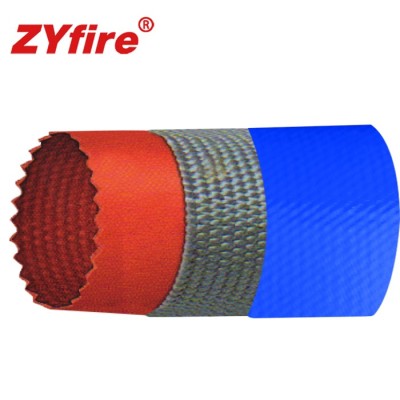
NBR rubber is inherently resistant to oils, fuels, and solvents. But not all NBR hoses are created equal. The key is in the formulation and construction. ZYfire Hose Corporation uses a proprietary NBR compound that enhances abrasion resistance by 50% compared to standard NBR. The cover is also compounded with anti-ozonants and UV stabilizers to withstand outdoor exposure. Additionally, the reinforcement layers are designed to bond tightly with the NBR cover, preventing delamination. For example, our NBR rubber covered hose has a abrasion resistance of less than 100 mm³ loss in DIN abrasion tests, compared to 200 mm³ for typical hoses. This means longer service life and fewer replacements.
Customer Success Stories
Case 1: Oil Refinery in Texas, USA
John Matthews, a maintenance manager at a major refinery in Houston, was struggling with hoses that failed every 3 months due to oil exposure. After switching to ZYfire's NBR rubber covered hose, the hoses lasted over 18 months. "We've reduced hose replacements by 80%, saving us over $200,000 annually," says Matthews. "The NBR cover stands up to the toughest oils."
Case 2: Construction Company in Germany
Klaus Schmidt, procurement manager at a construction firm in Munich, needed hoses that could handle rough concrete and gravel. Standard hoses lasted only 2 months. With ZYfire's NBR hose, they lasted 12 months. "The abrasion resistance is incredible," says Schmidt. "We've cut downtime by 70% and our workers feel safer."
Case 3: Agricultural Cooperative in Australia
Sarah Thompson, operations director at a farming cooperative in Queensland, used hoses for irrigation that cracked after one season due to UV exposure. ZYfire's NBR hose with UV stabilizers lasted 3 seasons. "We've saved over $50,000 in replacement costs and water loss," says Thompson. "The hoses are still going strong."
Case 4: Mining Company in Chile
Carlos Reyes, site manager at a copper mine in Antofagasta, faced frequent hose failures from abrasion and ozone. ZYfire's NBR hose lasted 4 times longer than previous hoses. "We've reduced maintenance costs by 60%," says Reyes. "The hoses are tough enough for our harsh environment."
Case 5: Chemical Plant in Japan
Yuki Tanaka, plant engineer in Osaka, needed hoses resistant to solvents. ZYfire's NBR hose showed minimal swelling and lasted 2 years. "We've eliminated leaks and improved safety," says Tanaka. "The technical support from ZYfire was excellent."
Applications and Partnerships
NBR rubber covered hose is ideal for a range of applications, including:
- Oil and fuel transfer
- Hydraulic systems
- Chemical processing
- Agriculture irrigation
- Mining and construction
- Marine and offshore
ZYfire Hose Corporation partners with leading distributors and OEMs worldwide. For instance, we supply NBR hoses to a major European distributor who serves the automotive industry. Our hoses are also specified by a global mining equipment manufacturer for their hydraulic systems. These partnerships are built on our commitment to quality and technical expertise.
FAQ
Q1: What is the temperature range for NBR rubber covered hose?
A: NBR hoses typically operate from -30°C to +100°C, but ZYfire's advanced formulation extends the upper limit to +120°C for short periods. Always consult the technical datasheet for specific applications.
Q2: Can NBR hose handle biodiesel?
A: Yes, NBR has good resistance to biodiesel, but the blend matters. ZYfire's NBR compound is tested with B20 and B100 biodiesel and shows minimal swelling. For higher concentrations, we recommend our specialized FKM hose.
Q3: How does NBR compare to EPDM for outdoor use?
A: EPDM has better ozone and UV resistance, but NBR outperforms in oil resistance. For outdoor applications with oil exposure, ZYfire's NBR hose with UV stabilizers offers the best of both worlds.
Q4: What standards does ZYfire's NBR hose meet?
A: Our NBR hoses meet SAE J517, EN 853, and ISO 1436 standards. They are also tested to DIN abrasion and ISO 1817 for fluid resistance.
Q5: How can I verify the quality of NBR hose?
A: Look for test reports on abrasion, oil resistance, and ozone resistance. ZYfire provides third-party test certificates and can supply samples for your own testing.
Conclusion and Call to Action
NBR rubber covered hose is a game-changer for industries facing oil, abrasion, and weather challenges. By choosing a high-quality NBR hose from ZYfire Hose Corporation, you can extend service life, reduce downtime, and save money. Don't settle for premature failures. Download our technical white paper on NBR hose performance or contact our sales engineers to discuss your specific application. Visit our website or reach out today to learn more.
Related News
More >-
![Why Blue Layflat Hose? The Ultimate Guide]()
Why Blue Layflat Hose? The Ultimate Guide
1. Introduction: The question and the answer 2. Pain Points in Industrial Hose Applications 3. The Blue Layflat Hose Solution 4. Customer Success Stories 5. Applications and Partnerships 6. FAQ for Engineers and Procurement Managers 7. Conclusion and Call to Action
-
![Why Sexless Hose Couplings Are Revolutionizing High-Pressure Industrial Systems]()
Why Sexless Hose Couplings Are Revolutionizing High-Pressure Industrial Systems
1. Introduction: The Hidden Cost of Coupling Failures 2. Pain Points: Leakage, Maintenance Downtime, and Safety Hazards 3. Solution: How Sexless Hose Couplings Eliminate These Issues 4. Customer Success Stories 5. Applications and Partnerships 6. FAQ for Engineers and Procurement Managers 7. Conclusion and Call to Action
-
![Is 50 ft the Optimal Length for Fire Hose?]()
Is 50 ft the Optimal Length for Fire Hose?
1. Introduction: The 50 ft Fire Hose Question 2. Industry Pain Points: When 50 ft Falls Short 3. The Engineering Answer: Why 50 ft Works 4. Real-World Success: Case Studies 5. Applications and Partnerships 6. FAQ for Engineers and Procurement 7. Conclusion and Call to Action
-
![Is Your Key Combat Ready Hose Truly Ready?]()
Is Your Key Combat Ready Hose Truly Ready?
1. Introduction: The critical moment that tests your hose
2. Pain Point 1: Kinking and flow restriction under pressure
3. Pain Point 2: Abrasion and environmental degradation
4. Pain Point 3: Coupling failures and incompatible connections
5. Solutions: Engineering a truly combat ready hose
6. Customer Success Stories
7. Applications and Partnerships
8. FAQ for Engineers and Procurement Managers
9. Conclusion and Call to Action -
![Why 75 Foot Coiled Garden Hose Is a Game Changer?]()
Why 75 Foot Coiled Garden Hose Is a Game Changer?
-
![Why PE Hose Is the Hidden Hero of Industrial Safety?]()
Why PE Hose Is the Hidden Hero of Industrial Safety?
This article explores the critical role of PE hose in industrial applications, addressing common pain points, offering solutions, and showcasing real-world successes. It includes FAQs and a call to action for technical resources.
-
![Why 50 Foot Fire Hose Outperforms Shorter Lines?]()
Why 50 Foot Fire Hose Outperforms Shorter Lines?
A detailed technical blog exploring the critical role of 50-foot fire hose in industrial fire protection, addressing common pain points, solutions, real-world case studies, applications, FAQs, and a call to action for professional guidance.
-
![Why Choose ZYfire Hose for Chemical Industry?]()
Why Choose ZYfire Hose for Chemical Industry?
Get the latest price? We'll respond as soon as possible(within 12 hours)