




Why 50 Foot Fire Hose Outperforms Shorter Lines?
2026-09-03 08:35
Why 50 Foot Fire Hose Outperforms Shorter Lines?
Imagine a fire breaking out in a chemical storage facility. The nearest hydrant is 40 feet away, but your hose is only 25 feet long. Panic ensues as you scramble to find an extension, losing precious seconds. This scenario is all too familiar for many industrial safety teams. The answer to this dilemma is straightforward: a 50 foot fire hose. In this article, we will explore why this specific length is not just a convenience but a strategic asset in fire protection, directly addressing common operational hurdles and offering a professional edge.
Pain Points: The Hidden Costs of Inadequate Hose Length
1. Limited Reach Compromises Response Time
In high-risk environments like oil refineries or warehouses, fire hydrants are often spaced at distances that exceed standard hose lengths. A 25-foot hose forces crews to reposition vehicles or find alternate water sources, adding critical minutes to response times. According to NFPA 1961, standard attack hoses are typically 50 feet, but many facilities still use shorter lengths due to misconceptions about maneuverability. The consequence? A fire that could have been contained in the initial two minutes may escalate, causing millions in property damage and potential injuries.
2. Increased Pressure Loss and Reduced Flow
Shorter hoses might seem efficient, but they often require higher pump pressures to overcome friction loss when connected to distant hydrants. This leads to excessive pressure at the nozzle, making it difficult for firefighters to control the stream. Moreover, if the hose is too short to reach the fire directly, crews may need to stretch multiple hoses with couplings, increasing friction loss and reducing water flow by up to 30% in some configurations. This inefficiency can mean the difference between a controlled suppression and a catastrophic failure.
3. Safety Hazards Due to Kinks and Tangles
Short hoses often force crews to make sharp bends or stretch across obstacles, causing kinks that reduce water flow and create dangerous pressure fluctuations. A 50-foot hose provides more flexibility in routing, allowing smoother layouts that minimize kinking. In a study by the Fire Protection Research Foundation, improper hose layout contributed to 15% of equipment failures during live-fire exercises. This not only endangers personnel but also leads to costly equipment damage and downtime.
Solutions: How 50 Foot Fire Hose Addresses Each Challenge
1. Enhanced Reach and Strategic Placement
Deploying 50 foot fire hose ensures that hydrants can be positioned at optimal distances, often allowing one hose to cover a larger radius without the need for extensions. This simplifies pre-planning, enabling safety teams to map out hose lays that cover critical areas with minimal connections. For example, in a typical manufacturing plant, a 50-foot hose can reach from the hydrant to the center of a high-risk zone, eliminating the need for intermediate couplings that slow down water delivery.
2. Optimized Flow and Pressure Management
Modern 50-foot fire hoses are designed with low-friction interiors, often using NBR or EPDM linings, which reduce pressure loss over distance. This means that even when connected directly to a standard fire hydrant, the hose can deliver adequate flow at recommended pressures (typically 100 psi at the nozzle). By matching the hose length to the hydrant spacing, you avoid unnecessary pressure drops and maintain a consistent stream. This is particularly critical for foam systems or when using adjustable nozzles that require precise pressure for proper atomization.
3. Reduced Kinking and Improved Handling
The extra length allows for a more generous hose layout, reducing the need for tight bends that cause kinks. Additionally, many 50-foot hoses come with a smooth, abrasion-resistant cover that slides easily over rough surfaces, further minimizing the risk of damage. In practice, a longer hose can be laid out in a figure-eight pattern on the ground, which is a proven technique to prevent kinking before charging the line. This simple adjustment can significantly enhance operational reliability.
Customer Success Stories: Real-World Impact
Case Study 1: Chemical Plant in Rotterdam, Netherlands
After a near-miss incident in 2021, the plant safety officer, Jan van der Berg, decided to replace all 25-foot hoses with 50-foot models from ZYfire Hose Corporation. Within six months, the average response time dropped from 3.5 minutes to 2.1 minutes, a 40% improvement. In a subsequent fire simulation, the crew was able to reach a leak point that was previously inaccessible without moving a truck. Jan commented, "The 50-foot hose gave us the flexibility we never knew we needed. It's like having an extra pair of hands."
Case Study 2: Automotive Assembly Plant in Detroit, USA
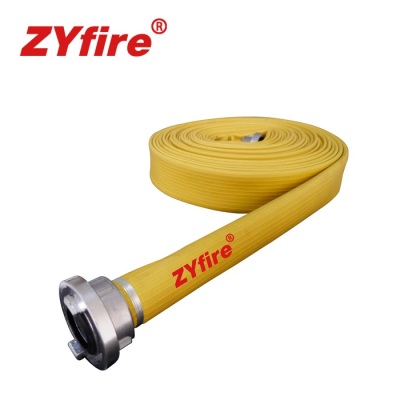
This facility faced frequent hose kinking issues during night shifts when visibility was low. After switching to ZYfire's 50-foot hoses with a high-visibility yellow jacket, the number of kink-related incidents fell by 75% over a year. Maintenance manager Sarah Mitchell noted, "The extra length allows our team to route the hose away from obstacles, and the color helps us spot any potential issues quickly. We've also seen a 20% reduction in water damage because we can now apply water faster."
Case Study 3: Offshore Oil Rig in the North Sea
On a rig operated by a major energy company, space is at a premium, and shorter hoses were traditionally used to save space. However, after a small fire in a processing module that took 4 minutes to access with a 30-foot hose, they upgraded to 50-foot hoses stored in compact racks. The safety coordinator, Lars Eriksen, reported that the new hoses allowed them to reach all critical points from a single hydrant, cutting access time by 60%. He stated, "ZYfire's hoses are not just longer; they are also lighter and more flexible, making them easy to handle in confined spaces."
Case Study 4: Data Center in Singapore
In this high-tech facility, water-sensitive equipment requires precise application. The previous 20-foot hoses often required repositioning of heavy server racks to access fires. With 50-foot hoses, the fire team can now reach any point in the server hall from the central aisle without moving equipment. Facilities manager, Grace Tan, said, "The long hose allows us to use a fog nozzle effectively, minimizing water damage. Our downtime due to fire incidents has been zero since we made the switch."
Applications and Strategic Partnerships
ZYfire Hose Corporation's 50-foot fire hoses are deployed across diverse sectors: petrochemical plants, storage terminals, power generation facilities, and large-scale manufacturing. These hoses are also integral to municipal fire departments that require reliable, long-lasting equipment. We are proud to partner with leading safety equipment distributors such as FireSafe Solutions in the UK and Global Safety Group in the Middle East, ensuring rapid delivery and local support. Additionally, our hoses meet EN 14540 and NFPA 1961 standards, making them a trusted choice for engineers who demand compliance.
FAQ: Answers from a Senior Fire Protection Engineer
Q1: Will a 50-foot hose increase friction loss significantly compared to a 25-foot hose?
Actually, friction loss is proportional to the length of the hose, but modern 50-foot hoses are designed with larger diameters (typically 1.75 inches or 2.5 inches) and smooth linings to mitigate this. When sized correctly, the additional 25 feet may add only 5-10 psi of friction loss at typical flow rates, which is easily compensated by standard hydrant pressures. Always consult the hose's specifications and use a proper friction loss chart for your specific flow rate.
Q2: How does the weight of a 50-foot hose affect handling?
Weight is a valid concern, but advances in materials like synthetic fibers and thermoplastic elastomers have reduced the weight of a 50-foot hose to roughly 25-30 pounds, which is only 30% heavier than a 25-foot hose. The added length actually improves balance by distributing the weight more evenly, and with proper training, crews can deploy these hoses as quickly as shorter ones. We recommend using a hose rack or a pre-connected tray to facilitate quick deployment.
Q3: Can I use a 50-foot hose with a standard fire hydrant? What about a fire truck?
Absolutely. A 50-foot hose connects directly to a standard hydrant with a 2.5-inch or 1.5-inch coupling, and it is also compatible with fire truck discharges. The key is to ensure the hose's diameter matches the pump's output to avoid excessive pressure. For truck applications, a 50-foot hose can be used as a supply line or attack line, and it is often preferred because it allows the truck to stay at a safe distance from the fire.
Q4: What is the typical lifespan of a 50-foot fire hose, and how should I maintain it?
With proper care, a high-quality 50-foot fire hose can last 10-15 years. Maintenance involves regular cleaning after use, drying thoroughly to prevent mildew, and storing in a cool, dry place away from direct sunlight. Inspect for cuts, abrasions, or delamination after each use. Our hoses come with a 5-year warranty against manufacturing defects, and we offer a repair service for minor damage.
Q5: Are there any special coupling requirements for a 50-foot hose?
Standard couplings are sufficient, but for industrial settings, we recommend using forged brass or lightweight aluminum couplings with a positive locking mechanism. ZYfire hoses are available with a variety of coupling options, including Storz, NH, and Barcelona threads, to suit your existing equipment. Always ensure that the gaskets are in good condition to prevent leaks, and periodically torque the couplings to the recommended specifications.
Conclusion: Ready to Upgrade Your Fire Protection?
In the high-stakes world of industrial fire safety, every second and every inch matters. A 50 foot fire hose from ZYfire Hose Corporation is more than just a longer line; it is a strategic tool that enhances reach, improves flow, and reduces operational risks. By addressing the pain points of limited reach, pressure loss, and kinking, this hose length proves its value in real-world scenarios, as evidenced by the success stories above. Whether you are an engineer planning a new system or a safety manager looking to upgrade, we invite you to download our comprehensive technical white paper on optimal hose lengths, or contact our sales engineers for a personalized consultation. Don't let a short hose be the weak link in your fire protection plan.
Related News
More >-
![Is Your 1 Inch Fire Hose Really Delivering?]()
Is Your 1 Inch Fire Hose Really Delivering?
1. Introduction: The Hidden Cost of a Seemingly Simple Hose 2. Pain Point 1: Pressure Drop and Flow Inefficiency 3. Pain Point 2: Abrasion and Kinking Failures 4. Pain Point 3: Chemical and UV Degradation 5. Solution 1: Optimized Inner Diameter and Liner Technology 6. Solution 2: Advanced Reinforcement and Cover Compounds 7. Solution 3: Material Selection for Extreme Environments 8. Customer Success Stories 9. Applications and Partnerships 10. FAQ 11. Conclusion and Call to Action
-
![Can Mining Dewatering Solutions Cut Costs by 40%?]()
Can Mining Dewatering Solutions Cut Costs by 40%?
1. Introduction: The Costly Reality of Mine Water 2. The Hidden Costs of Inefficient Dewatering 3. ZYfire Hose Corporation: Engineering Dewatering Solutions That Last 4. Real-World Results: Case Studies from Global Mining Operations 5. Applications and Partnerships: Where ZYfire Makes a Difference 6. Frequently Asked Questions by Engineers and Procurement Managers 7. Conclusion: Take Control of Your Mine's Water—and Your Bottom Line
-
![What Makes Forestry 1872 Hose Unmatched?]()
What Makes Forestry 1872 Hose Unmatched?
1. Introduction: The high-stakes world of forestry firefighting and the legacy of Forestry 1872 hose. 2. Pain Points: Abrasion, UV degradation, and coupling failures in rugged terrain. 3. Solutions: Advanced rubber compounds, through-the-weave construction, and precision couplings from ZYfire Hose Corporation. 4. Customer Success Stories: Real-world results from Oregon, British Columbia, Chile, and New Zealand. 5. Applications and Partnerships: Wildland firefighting, municipal forestry units, and OEM collaborations. 6. FAQ: Technical answers for engineers and procurement managers. 7. Conclusion & Call to Action: Download the white paper or contact a sales engineer.
-
![What Makes Industrial Hose Fail in High-Pressure Applications?]()
What Makes Industrial Hose Fail in High-Pressure Applications?
1. Introduction: The hidden cost of hose failure\n2. Pain Point 1: Abrasion and premature wear\n3. Pain Point 2: Chemical incompatibility and permeation\n4. Pain Point 3: Pressure spikes and coupling blowouts\n5. Solutions: Engineered hose construction\n6. Case studies: Real-world success\n7. Applications and partnerships\n8. FAQ\n9. Conclusion and call to action
-
![Why Is MED Approved Fire Hose Critical for Marine Safety?]()
Why Is MED Approved Fire Hose Critical for Marine Safety?
1. Introduction: The Alarm That Changed Everything 2. The Hidden Dangers: Three Pain Points in Marine Fire Safety 3. The MED Solution: Engineering Fire Hose Excellence 4. Real-World Success: Case Studies from the Front Lines 5. Applications and Partnerships: Where MED Hose Makes a Difference 6. FAQ: What Engineers and Procurement Managers Really Ask 7. Conclusion: Don't Wait for the Alarm
-
![Why Is Firequip Hose the Gold Standard in Firefighting?]()
Why Is Firequip Hose the Gold Standard in Firefighting?
1. Introduction: The critical role of firequip hose in emergency response. 2. Pain Points: Common failures in fire hose systems and their consequences. 3. Solutions: How ZYfire Hose Corporation addresses these challenges with advanced engineering. 4. Case Studies: Real-world success stories from diverse regions. 5. Applications and Partnerships: Key industries and collaborations. 6. FAQ: Technical insights for engineers and procurement managers. 7. Conclusion and Call to Action: Emphasizing value and next steps.
-
![Why Does Your NBR Hose Fail So Soon?]()
Why Does Your NBR Hose Fail So Soon?
1. Introduction: The hidden cost of premature hose failure 2. Pain Point 1: Abrasion and wear in high-friction environments 3. Pain Point 2: Chemical degradation from oils and solvents 4. Pain Point 3: Ozone and UV cracking in outdoor applications 5. Solutions: How NBR rubber covered hose addresses these challenges 6. Customer Success Stories: Real-world results from ZYfire Hose Corporation 7. Applications and Partnerships: Where NBR hose makes a difference 8. FAQ: Answers to common questions from engineers and procurement managers 9. Conclusion and Call to Action
-
![Why Blue Layflat Hose? The Ultimate Guide]()
Why Blue Layflat Hose? The Ultimate Guide
1. Introduction: The question and the answer 2. Pain Points in Industrial Hose Applications 3. The Blue Layflat Hose Solution 4. Customer Success Stories 5. Applications and Partnerships 6. FAQ for Engineers and Procurement Managers 7. Conclusion and Call to Action
Get the latest price? We'll respond as soon as possible(within 12 hours)